
On this page
- Which Coding Bootcamps Are Still Enrolling?
- How to Read a Bootcamp’s Job Numbers
- Our Picks: The Best Coding Bootcamps for Your Shortlist
- The Best Coding Bootcamps Compared on Tuition
- Are Coding Bootcamps Worth It in 2026?
- Free and Cheaper Ways to Learn to Code First
- Seven Questions to Ask Before You Sign
- Best Coding Bootcamps FAQs
- Bottom Line: Prove It to Yourself First, Then Pick a Bootcamp
The best coding bootcamps in 2026 are Fullstack Academy for an affordable live online program, Hack Reactor for a classic full-time intensive, and Launch School if you’d rather learn slowly and deeply before paying for job help. But the bigger story this year is who’s missing. Several famous bootcamps have paused or closed, so many “best of” lists still recommend programs you can’t actually join.
This guide only includes bootcamps that were enrolling students in October 2026. For each one, you’ll see the tuition on its own site, how long it takes, and how strong its job-outcome evidence really is. I also added a status board of the big names that paused, closed or changed what they sell, because that’s the first thing you should check before you apply anywhere.
Short on time? Start with one of these three.
Best value live bootcamp
Fullstack Academy
Live online classes, 13 weeks full-time or 22 part-time, at a lower price than most rivals.
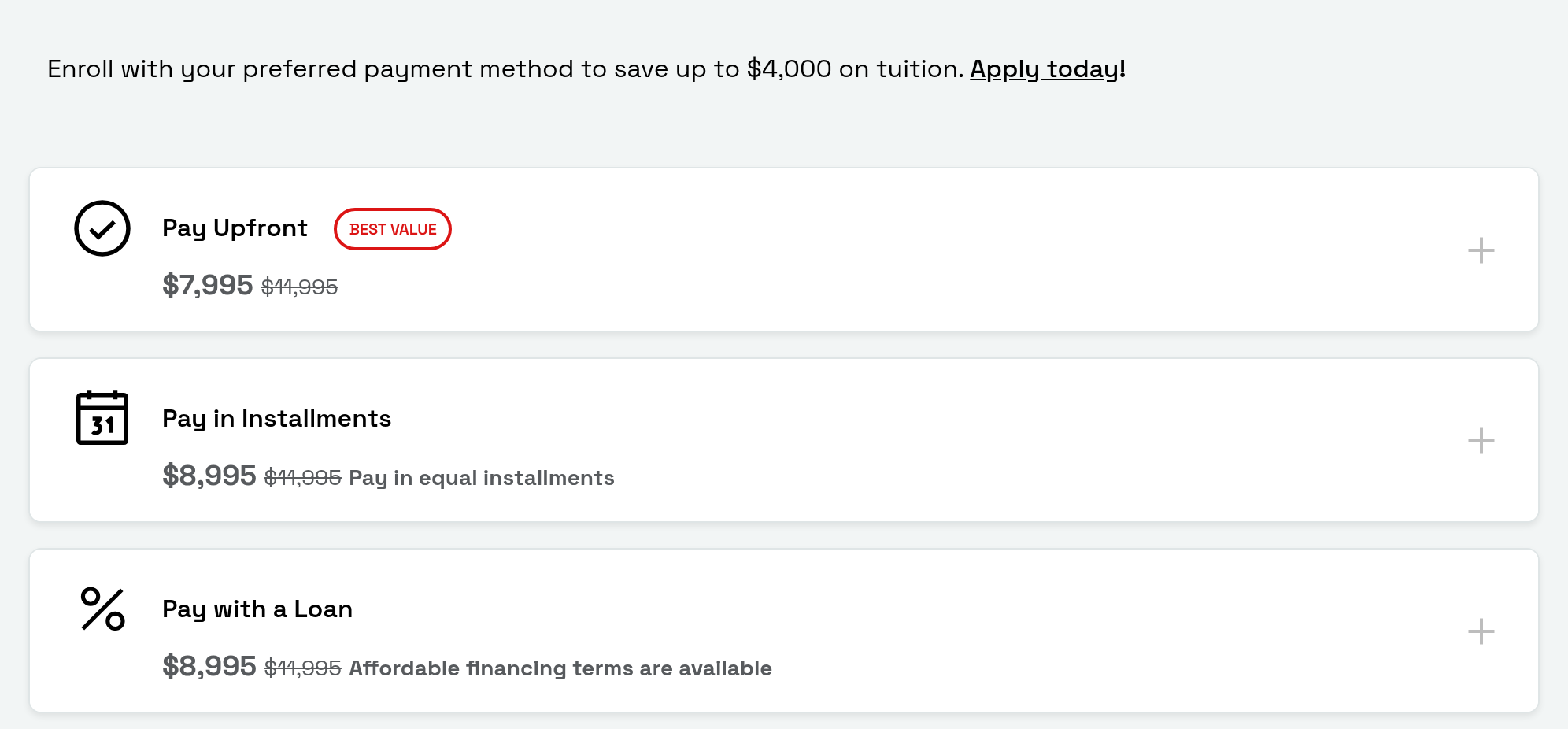
$11,995 list, $7,995 upfront
Best for deep fundamentals
Launch School
Self-paced, mastery-based study, with job support paid only after you’re hired.
$199/month, Capstone paid later
Best on a tight budget
Nucamp
Part-time programs built around a job, with weekly live workshops.
Most programs under $3,000
Which Coding Bootcamps Are Still Enrolling?
The bootcamp industry has shrunk fast. In late 2024, 2U announced it was closing the coding bootcamps it ran with universities, and its interim CEO said intensive bootcamps no longer align “with what the market wants and needs”. Others followed. Here’s the status of well-known programs as of October 2026, based on each school’s own website and public announcements:
| Bootcamp | Status, October 2026 | What changed |
|---|---|---|
| Fullstack Academy | Enrolling | Next full-time start listed for January 2027 |
| Hack Reactor | Enrolling | Now live online only; part-time track is back |
| Flatiron School | Enrolling | Online only; added a work-integrated apprenticeship program |
| Launch School | Enrolling | Capstone now runs two cohorts a year |
| Code Platoon | Enrolling | 2027 cohorts posted |
| App Academy | Pivoted | Original immersive ended June 2025; now sells part-time AI tracks |
| Codesmith | Paused | No Immersive start date published; promoting free NYC programs |
| Tech Elevator | Paused | No current cohorts listed |
| BloomTech (formerly Lambda School) | Closed | Last day of instruction December 31, 2025 |
| Turing School | Closed | No longer enrolling |
Statuses change quickly, so confirm a start date on the school’s own site before you do anything else. If a bootcamp can’t tell you when your cohort begins, keep looking.
How to Read a Bootcamp’s Job Numbers
Every bootcamp says its grads get hired. The useful question is who checked. Outcomes evidence comes in four levels, from strongest to weakest:
- CIRR-audited reports. CIRR is a shared reporting standard where schools publish placement rates and salaries for a full graduating class using the same definitions.
- A school’s own report with an outside review. Better than nothing, but check what the reviewer actually did.
- Self-reported numbers. A rate on the homepage with no cohort, date or definition behind it.
- No outcomes published. Some well-known schools now say outright that they don’t publish placement data.
Audited numbers also show how much the market has changed. Codesmith, long one of the best-performing bootcamps, reported that its 2023 graduating class of 865 students had 43.6% employed in the field at 180 days and 70.1% at 360 days, with a $115,000 median base salary for those placed. A few years earlier, its six-month rate was around 80%. So even at a strong school, plan for a job search that may take most of a year.
Our Picks: The Best Coding Bootcamps for Your Shortlist
These eight were enrolling in October 2026. Tuition comes from each school’s own site, and I’ve noted how strong each one’s outcome evidence is.
1. Fullstack Academy: Best Value Live Online Bootcamp
- Tuition
- $11,995 list; $7,995 if paid upfront
- Length
- 13 weeks full-time or 22 weeks part-time
- Format
- Live online
- Outcome proof
- Own report with outside review, 2021 grads
Go to Fullstack Academy Opens fullstackacademy.com
Fullstack Academy is the best value among the classic, instructor-led bootcamps still running. Its software engineering program lists $11,995, with limited-time prices of $7,995 upfront or $8,995 on a 0% installment plan or loan. The full-time track meets weekdays from 10am to 2pm Eastern for 13 weeks, which leaves time for homework and projects. The part-time track runs 22 weeks, three evenings a week.
The weak spot is its data. Its most recent outcomes figures cover 2021 graduates: 72% employed in the field within a year, with an $88,561 average starting salary. That was a much easier hiring market, so ask admissions for anything newer.
2. Hack Reactor: Best Classic Full-Time Intensive
- Tuition
- $19,480; $2,500 merit scholarship available
- Length
- 16 weeks full-time or 30 weeks part-time
- Format
- Instructor-led online
- Outcome proof
- Doesn’t publish placement data
Go to Hack Reactor Opens hackreactor.com
Hack Reactor is one of the oldest names in coding bootcamps, and it’s still built around the full-time, all-in model. Its Beginner Coding Bootcamp costs $19,480, and applicants who pass its aptitude test can get a $2,500 merit scholarship. (Hack Reactor’s tuition page wasn’t loading when we rechecked on November 1, 2026, so confirm the current price with admissions.) The full-time track runs 40 to 60 hours a week for 16 weeks, so you can’t hold a job alongside it. A 30-week part-time option is also listed.
Two things to know. Hack Reactor is part of Galvanize, which is owned by Stride, and it says plainly that it doesn’t publish placement data. Its alumni survey reports strong long-term earnings, but that describes people years into their careers, not first-job results. It also doesn’t accept applications from North Dakota, New Mexico or Nevada.
3. Launch School: Best for Deep Fundamentals
- Tuition
- $199/month for Core; Capstone is 18% of first-year salary or $18,000, whichever is higher
- Length
- Self-paced Core, then a 16-week Capstone
- Format
- Online; Capstone on a US Pacific schedule
- Outcome proof
- School-published Capstone results by year
Go to Launch School Opens launchschool.com
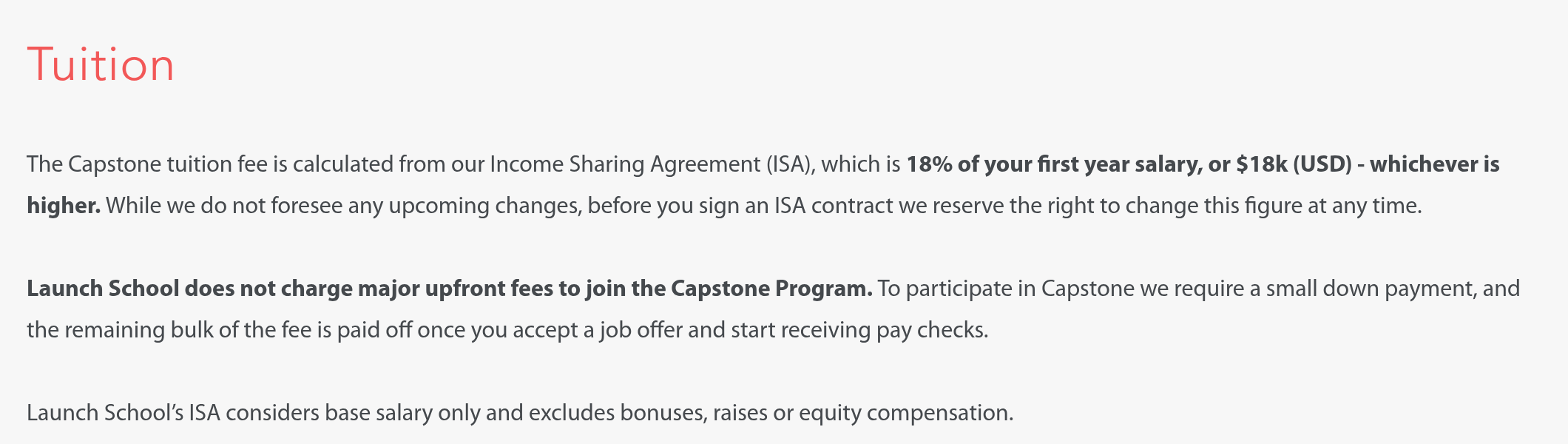
Launch School isn’t a bootcamp in the 12-week sense, and that’s its appeal. You pay $199 a month for its Core curriculum and move on only after you pass each assessment. Most people take a long time, but they come out with stronger fundamentals than a short program can give.
Strong Core students can apply to Capstone, a 16-week program followed by a job search, which you pay for mostly after you start working. It’s selective, and it expects 45 to 60 hours a week. Its published results have slipped with the market: 92.3% of 2022 Capstone students accepted software engineering offers, compared with 61.7% in 2025, at a $115,000 median US base salary.
4. Flatiron School: Best for Earning While You Learn
- Tuition
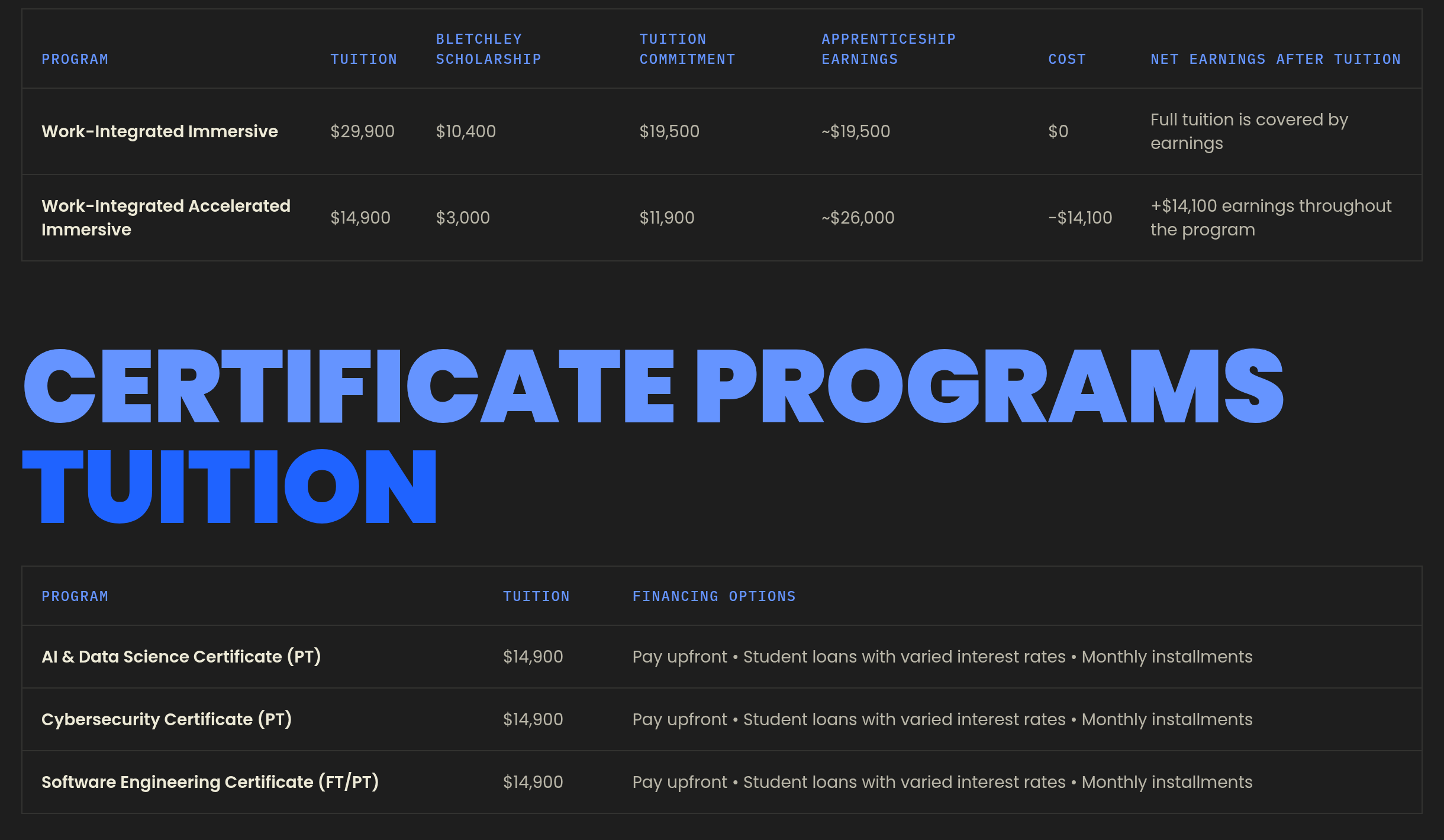
- $14,900 certificate; $29,900 Work-Integrated Immersive before scholarship
- Length
- 4 months full-time, 13 months part-time, or 19 months work-integrated
- Format
- Live online
- Outcome proof
- Self-reported salary survey
Go to Flatiron School Opens flatironschool.com
Flatiron School now sells two very different things. Its Software Engineering Certificate is a standard bootcamp at $14,900, taking about four months full-time or 13 months part-time. Its Work-Integrated Immersive is newer: $29,900, minus a $10,400 scholarship, combined with a paid apprenticeship that Flatiron says covers the remaining tuition through your earnings.
That second model is the most interesting idea in bootcamps right now, because it puts real work experience on your resume. Read the apprenticeship terms closely before you sign, since the math depends on that job. Flatiron’s latest outcomes post is a small salary survey rather than a placement rate.
5. App Academy: Best for Paying After You’re Hired
- Tuition
- $10,000; $4,000 upfront offer; $8,500 deferred
- Length
- 4 months for AI Software Engineering
- Format
- Online, mostly part-time
- Outcome proof
- Older campus data only
Go to App Academy Opens appacademy.io
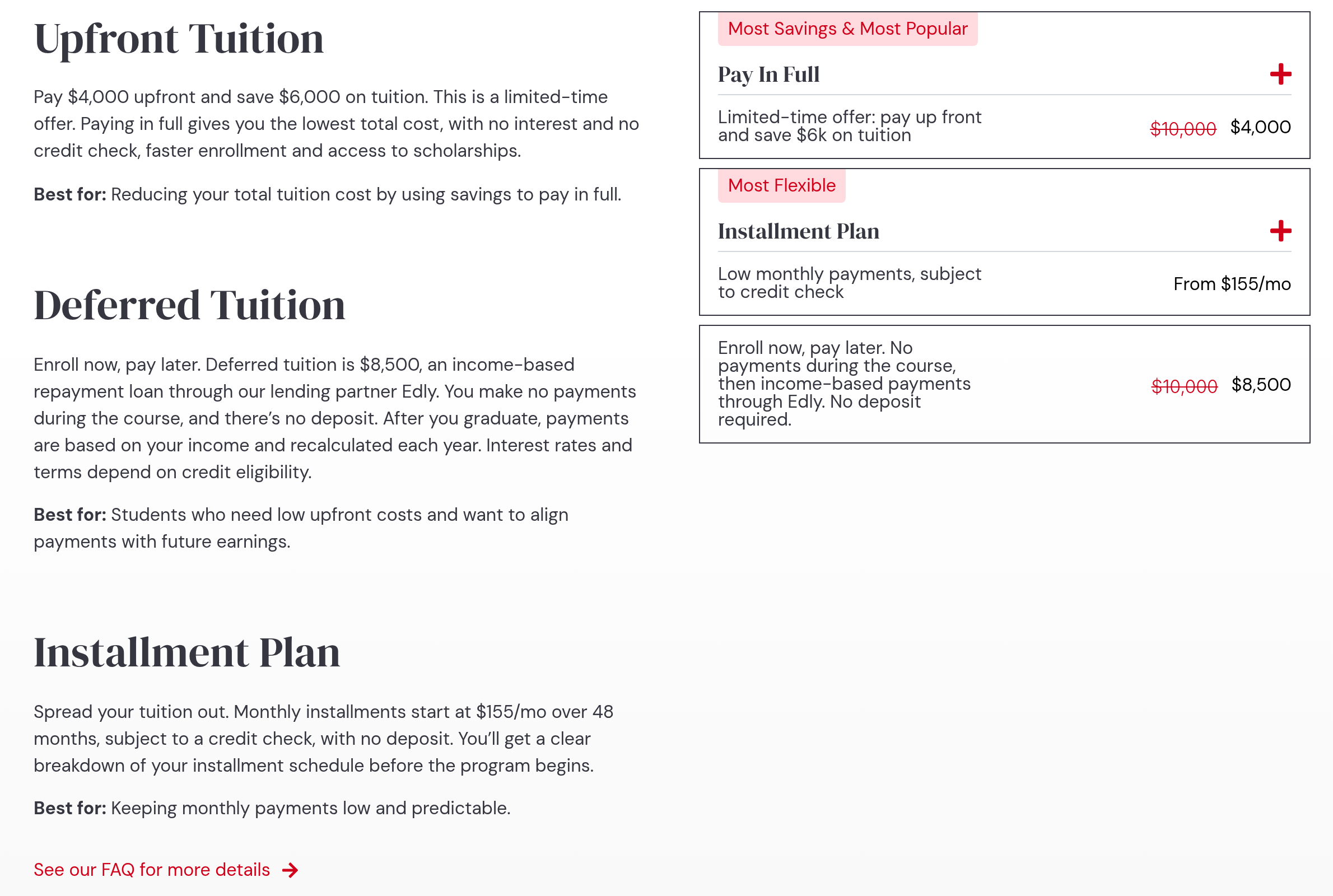
App Academy ended its famous full-time immersive in June 2025 and now focuses on shorter, part-time AI tracks, including a four-month AI Software Engineering program covering Python, SQL, FastAPI and retrieval-augmented generation. Its tuition page lists one price for every program, $10,000, with a limited-time $4,000 upfront option, an $8,500 deferred plan through its lending partner Edly, or installments from $155 a month.
The deferred plan is the draw if you can’t pay now, but treat it like a loan and read the repayment terms. App Academy’s headline placement figures come from 2019 campus graduates, so they don’t tell you much about the current program.
6. Code Platoon: Best for Veterans and Military Spouses
- Tuition
- $20,000, with GI Bill and need-based scholarships
- Length
- 15 weeks full-time or 28 weeks evenings and weekends
- Format
- In person in Chicago or live online
- Outcome proof
- Lists CIRR participation; latest report pending
Go to Code Platoon Opens codeplatoon.org
Code Platoon is a nonprofit bootcamp designed for veterans, military spouses and servicemembers. Tuition has been listed at $20,000, though Code Platoon’s program page no longer shows a price, so ask admissions for the current figure. Most students don’t pay that out of pocket. The Post-9/11 GI Bill covers tuition and housing for in-person students in Chicago, remote GI Bill students get a housing stipend from the school, and a pay-what-you-can scholarship can cover up to the full cost.
One 2026 change to note: VET TEC funding now covers only in-person Chicago attendance, according to published program details. If you’re counting on VA benefits, confirm your exact coverage with Code Platoon’s admissions team before you pick a format.
7. Nucamp: Best Budget Bootcamp
- Tuition
- $458 to about $2,600 for most programs
- Length
- 4 to 22 weeks
- Format
- Self-paced weekdays plus a live weekend workshop
- Outcome proof
- Self-reported
Go to Nucamp Opens nucamp.co
Nucamp costs a fraction of everything else on this list. Its 22-week Full Stack Web and Mobile Development program is about $2,600 in monthly payments, and a four-week web fundamentals course is $458. It’s built for people who keep their jobs: 8 to 14 hours of self-paced work during the week plus a four-hour live workshop on the weekend, with no more than 15 students per instructor.
You get less hands-on instruction and career support than a $15,000 program, and its outcome numbers are self-reported. For testing whether coding suits you before spending real money, though, it’s hard to beat.
8. Ada Developers Academy: Best Tuition-Free Option
- Tuition
- Free
- Length
- Cohort-based, including an internship
- Format
- Based in Seattle
- Outcome proof
- Self-reported
Go to Ada Developers Academy Opens adadevelopersacademy.org
Ada Developers Academy describes itself as “a tuition-free, cohort-based coding school” funded by donations, and it works with partner companies that host interns and hire graduates. It reports a 96% graduation rate and more than 1,200 graduates. Admission is competitive and eligibility is specific, so read the requirements on its site before you plan around it.
The Best Coding Bootcamps Compared on Tuition
Here’s the full list in one table, sorted from lowest to highest list price:
| Bootcamp | List tuition | Lowest way to pay | Length | Can you keep a job? |
|---|---|---|---|---|
| Ada Developers Academy | Free | Free | Cohort plus internship | No |
| Nucamp | $458 to about $2,600 | Monthly payments | 4 to 22 weeks | Yes |
| Launch School | $199/month | Pay as you go | Self-paced, then 16 weeks | Yes, until Capstone |
| App Academy | $10,000 | $4,000 upfront offer | 4 months | Yes |
| Fullstack Academy | $11,995 | $7,995 upfront offer | 13 or 22 weeks | Part-time only |
| Flatiron School | $14,900 | Work-integrated option | 4 to 19 months | Part-time only |
| Hack Reactor | $19,480 | $16,980 with merit scholarship | 16 or 30 weeks | Part-time only |
| Code Platoon | $20,000 | GI Bill or scholarship | 15 or 28 weeks | Part-time only |
Check Fullstack Academy dates Start Launch School Core
Are Coding Bootcamps Worth It in 2026?
A coding bootcamp can still be worth it, but only for a narrower group of people than five years ago. Entry-level developer hiring is tougher, AI tools have changed what junior work looks like, and even well-run bootcamps report longer job searches. The Codesmith and Launch School numbers above show the trend clearly.
A bootcamp makes the most sense if you already know you like coding, you’ve tried free material and want structure and accountability, and you can afford three to twelve months of job searching after you finish. It makes the least sense if you’re hoping a 12-week course alone will lead straight to a six-figure job. That promise was always optimistic, and in 2026 it’s misleading.
If you have a related background, such as data work, IT support or a technical field, a bootcamp can be a strong bridge, because you’re adding skills rather than starting from zero.
Free and Cheaper Ways to Learn to Code First
Before you spend thousands, spend a month on free material. If you still enjoy it, you’ll get far more out of a bootcamp. Good starting points:
- The Odin Project is a free, project-based web development curriculum with an active community.
- freeCodeCamp offers free certifications built around projects.
- Harvard’s CS50 courses are free online, with paid certificates optional.
- Per Scholas runs no-cost training in IT support, cybersecurity and data analytics, aiming for job-ready skills in three to four months.
- Your local community college often has low-cost programming classes that carry real credit.
Seven Questions to Ask Before You Sign
Ask every bootcamp these questions, and get the answers in writing:
- When does my cohort start, and how many students are in it?
- What were placement rates for graduates in the last 12 months, and who verified them?
- How do you define “employed in the field”?
- What exactly happens if I need to pause or withdraw, and how much is refunded?
- If I finance, what’s the interest rate and total repayment amount?
- How many hours a week will I really need, including homework?
- What career support continues after graduation, and for how long?
A school that answers clearly and quickly is usually a good sign. Vague answers on outcomes or refunds are a reason to walk away.
Best Coding Bootcamps FAQs
What is the best coding bootcamp in 2026?
For most people, Fullstack Academy offers the best mix of live instruction and price among bootcamps still enrolling. Hack Reactor suits people who can study full-time, and Launch School suits people who want deep fundamentals at their own pace.
How much does a coding bootcamp cost?
Most full bootcamps on this list cost $10,000 to $20,000 before discounts. Budget options like Nucamp cost under $3,000, and a few programs, such as Ada Developers Academy, are tuition-free.
Can you get a job after a coding bootcamp?
Yes, but it often takes longer than bootcamps once advertised. Codesmith’s audited 2023 class had 43.6% of graduates working in the field six months out and 70.1% after a year.
Are online coding bootcamps as good as in-person ones?
Most major bootcamps now teach live online, and the curriculum is the same. In-person options are rare; Code Platoon in Chicago is one of the few on this list.
Did Codesmith and App Academy close?
Not entirely. As of October 2026, Codesmith hasn’t published a start date for its Immersive and is promoting free NYC programs instead. App Academy ended its original immersive in June 2025 and now sells part-time AI programs.
Bottom Line: Prove It to Yourself First, Then Pick a Bootcamp
Spend a month on free material first. If you still want to code, choose Fullstack Academy for an affordable live program, Hack Reactor if you can commit full-time, or Launch School if you’d rather build deep skills before paying for job support. Veterans should look at Code Platoon first.
Whatever you pick, confirm a real start date, ask for recent verified outcomes and plan for a job search that may last months. The right bootcamp speeds you up, but it won’t do the job hunt for you.
You reached the last module. 3 in 100 do.
Keep going in Schools & Homeschool:
TopicSchools & Homeschool