
On this page
- Quick Answer: Babbel vs Duolingo
- Babbel vs Duolingo at a Glance
- What Is the Difference Between Babbel and Duolingo?
- How Much Do Babbel and Duolingo Cost in 2026?
- Which App Teaches You More?
- Which Is Better for Speaking?
- Which App Has More Languages?
- Which One Keeps You Studying?
- What Do Learners Complain About?
- Babbel and Duolingo Pros and Cons
- How Long Until You Can Hold a Conversation?
- Babbel vs Duolingo: Which Should You Choose?
- Can You Use Babbel and Duolingo Together?
- What Are the Best Alternatives to Babbel and Duolingo?
- Frequently Asked Questions
- Babbel vs Duolingo: Our Recommendation
Babbel vs Duolingo is a choice between paying about $7 to $9 a month for a structured course and learning for free through a daily game. If you want someone to explain the grammar properly, and you’re learning Spanish, French, German or Italian, pay for Babbel. If you can’t spend a dime, or your heart is set on Japanese or Korean, Duolingo wins by default. That’s where things stand in October 2026.
Very few Duolingo users pay anything at all, and that surprised me. The company reported 140.6 million monthly users and 12.7 million paying subscribers for the second quarter of 2026. That works out to fewer than 1 in 10 users paying. Babbel runs the opposite model: you get one free lesson per course, and then you hit a paywall.
Quick Answer: Babbel vs Duolingo
Babbel is my pick for most adults, as long as your language is one of its 14 and you’ll give it 15 minutes most days. It explains the grammar, its lessons are built on conversations you’d actually have, and university researchers found speaking gains within 12 weeks.
Stick with free Duolingo if money’s tight, if you need a game to pull you back each day, or if Babbel doesn’t offer your language. If you’re choosing between Super Duolingo and Babbel for Spanish or French, a year of either costs about the same, and I’d spend that money on Babbel.
Best for most adults
Babbel
Grammar explained in English, lessons built on real conversations, 14 languages.
About $83 to $108 a year
Best free option
Duolingo
A full free course with ads and an energy limit, in 40+ languages.
Free; Super about $80 to $120 a year
Babbel vs Duolingo at a Glance
| Babbel | Duolingo | |
|---|---|---|
| Free version | First lesson of each course only | Full course, with ads and an energy limit |
| Paid price (12 months) | About $83 to $108 a year | Super: about $80 to $120 a year |
| Languages | 14 | 40+ |
| Typical lesson length | 10 to 15 minutes | About 5 minutes |
| Teaching style | Dialogues plus explained grammar | Short drills, games and repetition |
| Speaking practice | Speech recognition in lessons | Speech exercises, AI Video Call on many Super accounts |
| Best for | Adults who want structure and clear explanations | Building a daily habit for free |
| Main weakness | Repetitive exercises, little past intermediate | Thin grammar, and a free tier capped by energy and ads |
What Is the Difference Between Babbel and Duolingo?
The difference between Babbel and Duolingo is how they teach. Babbel feels like a small class on your phone. You’re dropped into a short conversation (checking into a hotel, say, or ordering coffee), the app pauses to walk you through the grammar in English, and then it makes you put the sentences together yourself. Budget 10 to 15 minutes a lesson.
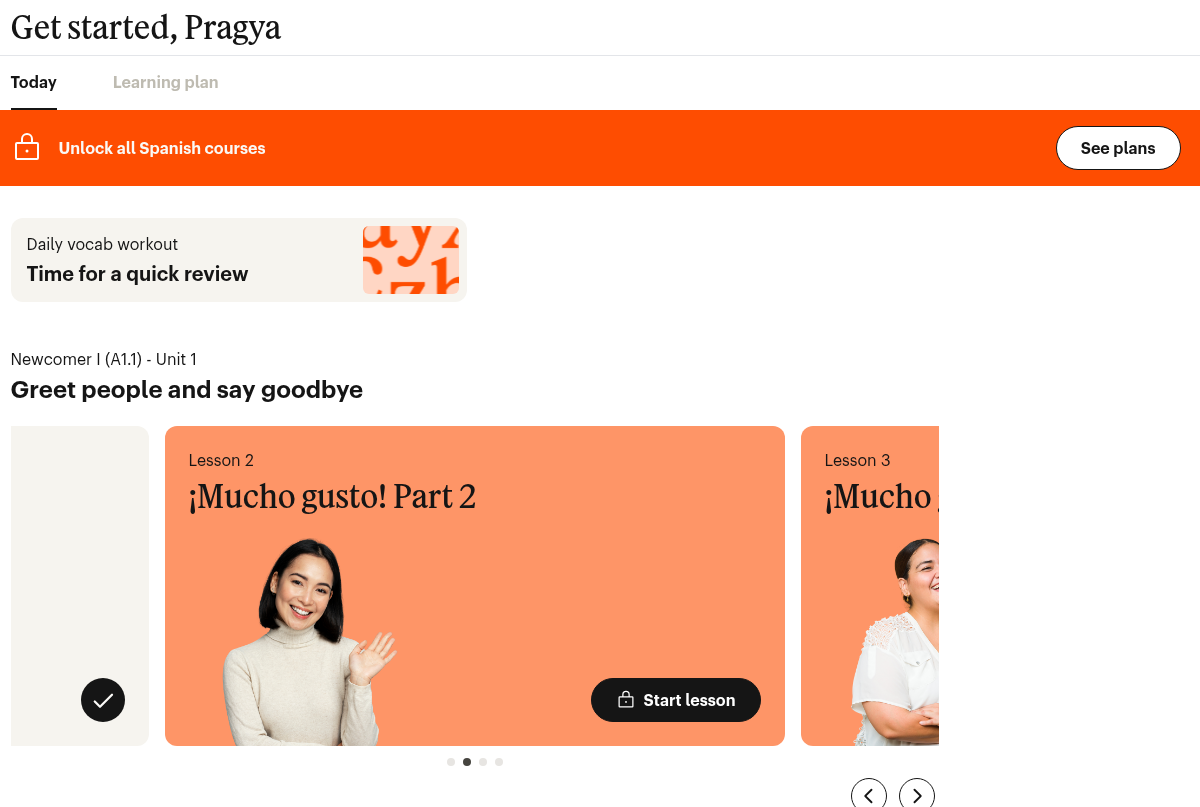
To see what you get without paying, we created a free Babbel account and completed Lesson 1 of the Spanish Newcomer course. Lesson 2 was locked behind a paid plan, and the free lesson covered vocabulary only. Babbel’s grammar tips and speaking practice need a subscription, and speaking exercises run only in the app.
Duolingo is a game first and a course second. A lesson takes about five minutes, and you earn points, protect a streak and climb a league. Words come back again and again within a unit, while grammar is mostly picked up from patterns, with the odd tip along the way.
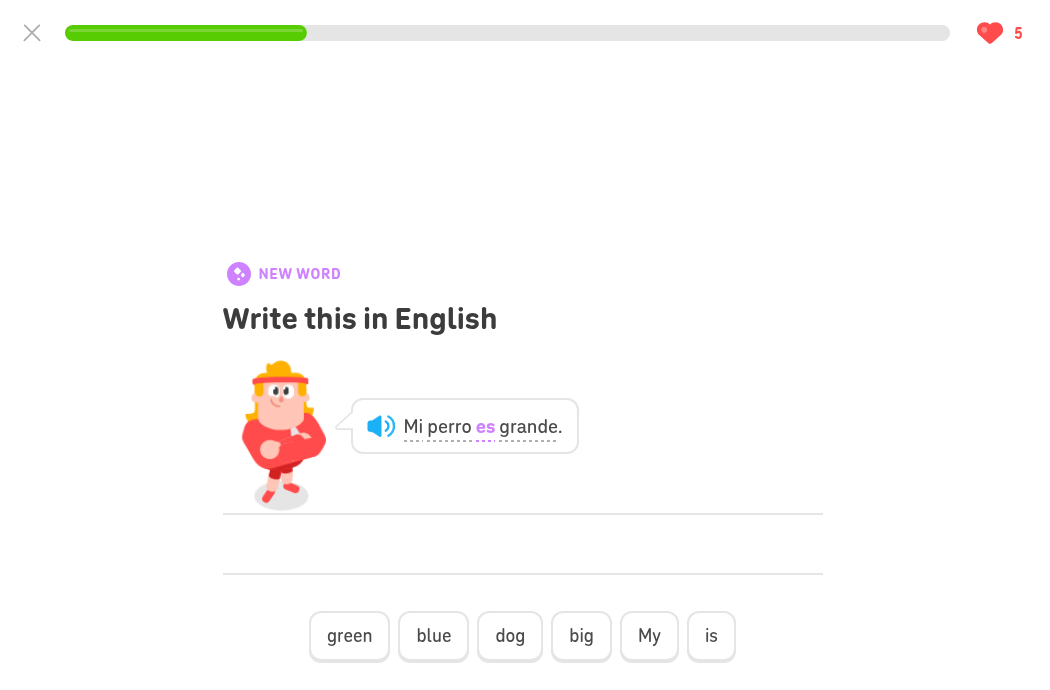
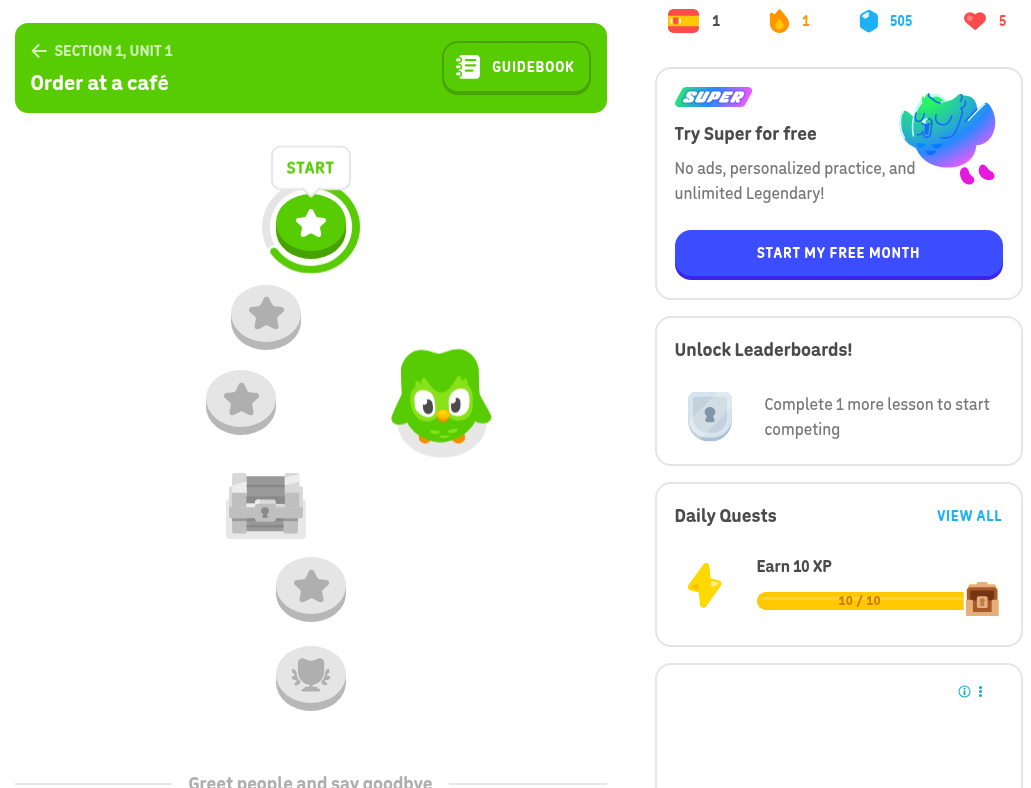
We also created a free Duolingo account and completed the first Spanish lesson, which was mostly tap-to-translate exercises like the one below.
I don’t know of an app that’s better at getting you to open it again tomorrow. The problem shows up later. Long-time users often say they can read a menu but freeze when the waiter asks them a question.
Your temperament should decide this as much as any feature. Some of us won’t trust a sentence until we know why it works, and Babbel feels calm and logical to that crowd. Others tune out the second they see the word “conjugation” and keep coming back only because a green owl sends guilt-trip notifications. For them, the game layer is the whole point.
How Much Do Babbel and Duolingo Cost in 2026?
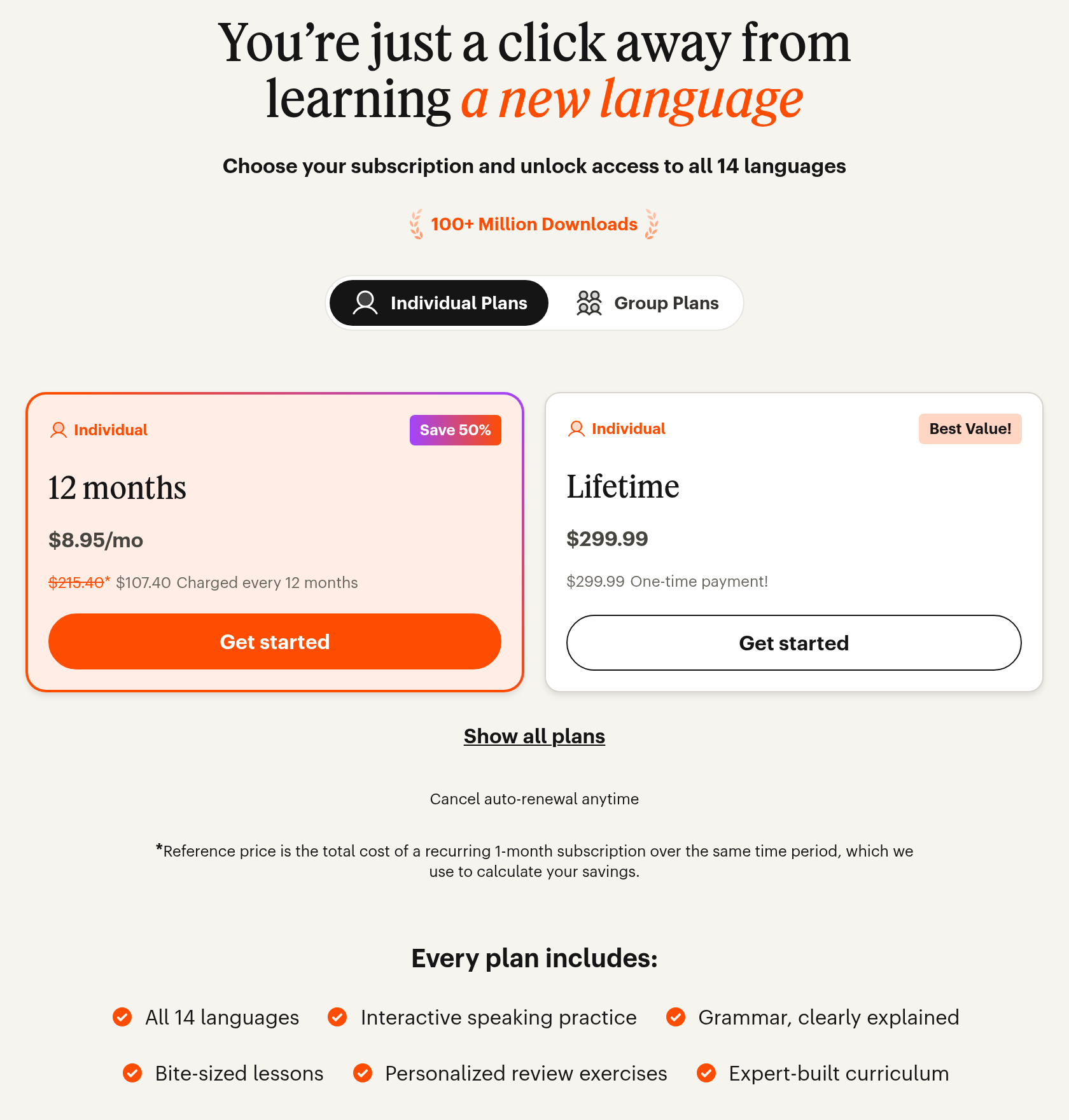
Babbel costs about $7 to $9 a month on a 12-month plan. Duolingo is free, and Super Duolingo runs roughly $80 to $120 a year in the US. I can’t give you one clean number for each, because neither company keeps prices fixed for long. Prices change by country, by platform and with every sale, so the table below uses Babbel’s own plans page where we could check it (November 1, 2026) and prices reported in 2026 otherwise, with the month.
| Plan | Price reported | Per month | Checked |
|---|---|---|---|
| Babbel, 3 months | $45.75 | $15.25 | Reported, June 2026 |
| Babbel, 12 months | $107.40 (sale; $215.40 reference price) | $8.95 | Babbel.com, Nov 2026 |
| Babbel, lifetime | $299.99 once | None | Babbel.com, Nov 2026 |
| Duolingo, free | $0 | $0 | Ads and energy limit |
| Super Duolingo, yearly | $79.99 to $119.99 | $6.67 to $10.00 | Reported, Oct 2026 |
| Super Duolingo, monthly | $12.99 to $16.99 | $12.99 to $16.99 | Reported, Sep 2026 |
| Super Family (6 people), yearly | $119.99 to $143.99 | $10.00 to $12.00 | Reported, Sep 2026 |
Compare the two yearly rows and you’ll see Babbel and Super Duolingo overlap almost completely. Once you upgrade Duolingo, Babbel is no longer the expensive option, so the useful question changes to this: what exactly are you buying?
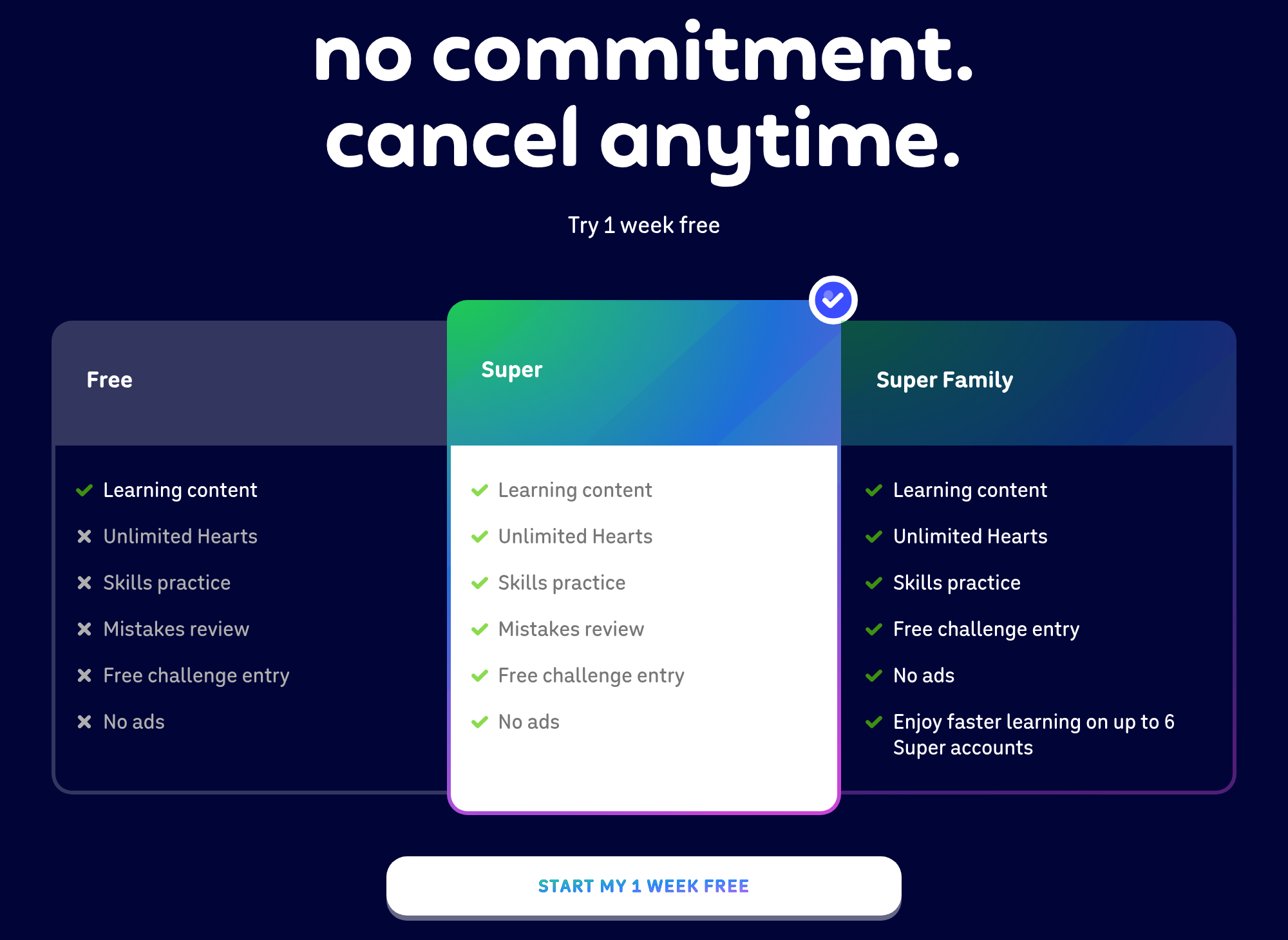
What the Free Version of Duolingo Limits
Free Duolingo holds you back with ads and an energy meter. The meter arrived in July 2025 as a replacement for hearts: lessons drain it, streaks of right answers top it up, and it refills over roughly a day. Once it’s empty you can wait, sit through an ad or burn gems. Some accounts are still stuck on hearts while Duolingo runs its tests.
Ours was one of them. The free account we created on November 1, 2026 still showed five hearts, not the energy meter.
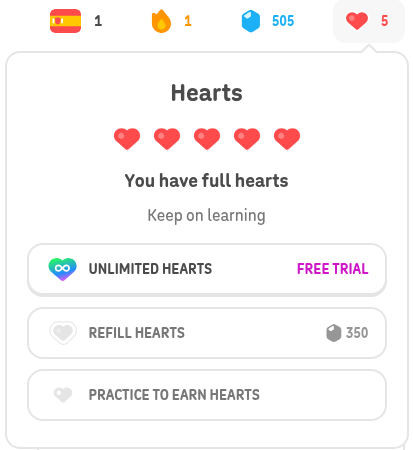
For a 15-minute-a-day learner this barely matters. For the Sunday binger who wants an hour straight, it’ll get annoying fast.
Paid plans are changing too. During the August 2026 earnings call, Duolingo said most free trials are stretching from 7 days to a month and AI Video Call is heading to Super. Executives also floated the idea that they “may actually sunset Max,” the top-priced tier (call transcript). If an app pop-up pushes Max at you, check what plain Super already includes first.
Babbel’s Plans and Refunds
Babbel offers 1, 3, 6 and 12-month plans, plus a lifetime option you pay for once. Commit longer and the monthly price falls; a 12-month plan comes in around half the 3-month rate. These days you mostly buy inside the app, which means your quote depends on where you live and whatever promo is running, and Babbel runs promos often. During sales the 12-month plan has dipped to about $6.95 a month, so I wouldn’t pay full price.
Refunds work differently depending on where you buy. Subscribe on Babbel’s website in the US and its terms promise a pro rata refund if you cancel during a renewal period. Go through the App Store or Google Play and you’re playing by Apple’s or Google’s refund rules.
Is lifetime worth it? Against a $90 to $108 yearly plan it breaks even in about three years. That makes sense if you’ll learn two languages, but it’s a stretch for one. One more thing, since older reviews still mention it: Babbel Live, the live tutoring add-on, is gone, per Babbel’s help center.
Which App Teaches You More?
Babbel and Duolingo can both point to published studies, and both studies found people learned something real. Before you take either at face value, though, check two things: what got measured, and who did the measuring.
| Babbel study | Duolingo study | |
|---|---|---|
| Published in | Foreign Language Annals, 2019 | Foreign Language Annals, 2022 |
| Run by | Michigan State University researchers; announced by Babbel | Duolingo’s own research team |
| What it measured | Speaking (oral interview), grammar, vocabulary | Reading and listening |
| Headline result | 59% gained at least one speaking sublevel in 12 weeks | 5 course units matched 4 university semesters |
| Main caveat | 54 of 85 students finished; 36% quit | No speaking results in the release |
What the Babbel Study Found
Michigan State University researchers put students on Babbel Spanish for 12 weeks. According to MSU’s write-up, 59% climbed at least one sublevel in speaking on the ACTFL scale, and among students who logged 15-plus hours that figure jumped to 75%.
Fifteen hours across 12 weeks works out to about 11 minutes a day, which most people can manage. Babbel’s marketing leaves out one detail: 85 students started, and only 54 finished.
What the Duolingo Study Found
Duolingo’s study came from Duolingo’s own learning scientists, which is worth keeping in mind. They tested Spanish and French learners on reading and listening. Finish five units, they found, and you score about the same as a college student four semesters in; finish seven and you’re level with five semesters (Duolingo press release, 2022).
That’s a strong result for comprehension. Speaking wasn’t tested, though, and it’s the exact skill people complain about after a year on Duolingo.
Put the two studies side by side and the split is clear. Duolingo has evidence, from its own team, that it builds reading and listening. Babbel has evidence, from university researchers, that it moves speaking. If talking to actual humans is your goal, I’d weigh that above every feature comparison you’ll read.
Which Is Better for Speaking?
Babbel beats free Duolingo for speaking. Lessons revolve around dialogues you finish out loud, and the review sessions keep circling back to whatever tripped you up. You also hear full exchanges at a natural pace, not one isolated sentence after another.
Paid Duolingo does have an answer here: Video Call, an AI conversation partner that the company says most new Super subscribers now get (Q2 2026 shareholder letter). If anything justifies paying Duolingo instead of Babbel, it’s this.
Still, neither app is a real person. The speech recognition in both is forgiving about wobbly pronunciation, and no app notices when your mind goes blank halfway through a sentence. Trying to hold real conversations in a few months? Book a tutor once or twice a week. That’ll move your speaking further than any upgrade.
Which App Has More Languages?
Duolingo, and it isn’t close. Babbel sticks to 14 languages, mostly European (Spanish, French, German, Italian, Portuguese, Polish, Swedish and a few more), and its pricing page says every plan covers all 14.
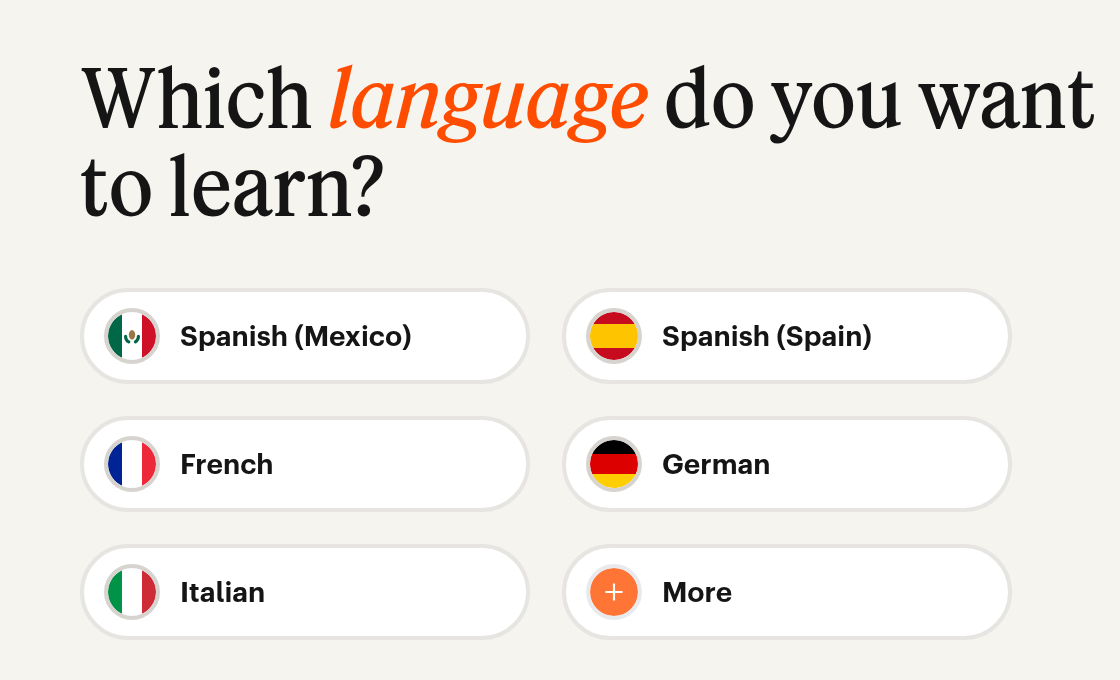
Duolingo’s App Store listing claims 40+, among them Japanese, Korean, Chinese, Arabic, Vietnamese and Hebrew. Babbel teaches none of those. So if your language isn’t on Babbel’s list, you can stop reading here and go with Duolingo.
Which One Keeps You Studying?
Duolingo is better at getting you to open the app; Babbel is better at moving paying learners through an actual curriculum. Both matter, because the thing most likely to sink your language goal isn’t choosing the wrong app. It’s quitting.
And people quit a lot. One study of 5.6 million learners on edX found that only 3% of everyone who enrolled finished, compared with 46% of those who paid. Those were online courses rather than language apps, so read it as a pattern, not a forecast. The idea still makes sense: when you pay and make a plan, you take the course more seriously. Babbel’s model depends on that. Duolingo leans on streaks, leagues and a steady stream of push notifications instead.
Think back to your last attempt at a language. Did it fall apart because you stopped showing up? Then Duolingo’s habit machinery is worth more to you than Babbel’s structure. Or did it fall apart because you got bored of drills that never turned into a conversation? Then pay for structure.
What Do Learners Complain About?
Each app draws its own set of complaints, and they repeat across app store reviews, Reddit threads and review sites. In fairness, both rate well on the US App Store: Duolingo sits at 4.7 stars from about 5.5 million ratings, Babbel at 4.6. The people complaining are a minority, but they’re loud and they keep saying the same things.
What Duolingo users gripe about most:
- Energy (or hearts) feeling like a punishment. One Trustpilot reviewer summed it up: “the hearts punish you for just guessing.”
- Ads between lessons on the free plan.
- Weird example sentences, which some reviewers pin on Duolingo’s move to AI-built course content.
- Free trials that quietly roll into a yearly charge.
- A streak that keeps growing while real conversation doesn’t.
What Babbel users gripe about most:
- Too few exercise types, so long sessions start to drag.
- Thin material once you get past intermediate.
- Long plans that auto-renew, and refund requests that come too late.
- Nothing meaningful to try before you pay.
Read both lists and you’ll see a pattern. Babbel’s critics mostly argue it isn’t enough for the money. Duolingo’s critics mostly argue it doesn’t teach deeply enough, and that it nags. Which of those would bother you more?
Babbel and Duolingo Pros and Cons
| Pros | Cons | |
|---|---|---|
| Babbel |
|
|
| Duolingo |
|
|
In short, Babbel’s weak spots are about value, while Duolingo’s are about depth. Pick the trade-off you can live with.
How Long Until You Can Hold a Conversation?
Spanish takes about 30 weeks of full-time training to reach professional working proficiency, says the US Foreign Service Institute. It puts Category I languages, Spanish, French and Italian among them, at 552 to 690 class hours, and that’s with teachers plus homework. No app will carry you all the way there. But the number does explain why 5 minutes a day can feel like walking up a down escalator.
| Daily study | Hours per year | Years to 690 hours |
|---|---|---|
| 5 minutes (one Duolingo lesson) | 30 | About 23 |
| 15 minutes (one Babbel lesson) | 91 | About 7.6 |
| 30 minutes | 183 | About 3.8 |
| 60 minutes | 365 | About 1.9 |
You won’t need anything close to professional level to order dinner or chat with a host family; basic conversation comes much sooner. Even so, the table explains a very common Duolingo regret. A 400-day streak of 5-minute lessons adds up to roughly 33 hours of study. That’s a good start, but it’s a small slice of the job.
Babbel vs Duolingo: Which Should You Choose?
It comes down to your goal, your language and your budget. Find yourself in the table:
| Your situation | Pick | Why |
|---|---|---|
| Trip in 3 to 6 months, want basic conversation | Babbel | Dialogue-based lessons on travel situations |
| Zero budget | Duolingo free | A full course with limits you can live with |
| Learning Japanese, Korean, Chinese or Arabic | Duolingo | Babbel doesn’t teach them |
| You keep quitting language apps | Duolingo | Streaks and reminders are its strongest feature |
| You want grammar explained in plain English | Babbel | Explanations are part of every lesson |
| Already paying for Super, Spanish or French | Keep Super if you use Video Call | AI conversation practice is its best feature |
| Need to speak confidently soon | Babbel plus a tutor | Apps alone don’t build fluent speaking |
Can You Use Babbel and Duolingo Together?
You can, and that combo works better for a lot of people than either app alone. Make Babbel the main course, 15 minutes a day, and keep free Duolingo around for 5 minutes of vocab on the bus or in line at the grocery store. You’d only be paying for Babbel, around $83 to $108 a year.
What I wouldn’t do is pay for both. Super Duolingo and Babbel cover too much of the same ground to justify two subscriptions.
What Are the Best Alternatives to Babbel and Duolingo?
That depends on what’s missing for you.
- Pimsleur is audio-first and all about speaking and listening, which makes it a natural fit for a commute.
- Rosetta Stone teaches entirely in the target language, no translations. People tend to love it or find it painfully slow.
- Preply and italki pair you with human tutors, so you get the one thing neither app can give you: real conversation.
Frequently Asked Questions
Is Babbel better than Duolingo?
For structured learning, grammar and early speaking practice, yes, Babbel is better than Duolingo, provided your language is one of its 14. Duolingo is the better free habit builder and the only one of the two that covers Japanese, Korean or Chinese.
Is Babbel worth it if Duolingo is free?
If you’ll put in 10 to 15 minutes most days, Babbel is worth it. At about $7 to $9 a month on a yearly plan, it’s one of the cheaper structured courses out there. Only studying a couple of times a month? Save your money and stay on free Duolingo.
Can Duolingo make you fluent?
Not on its own. Duolingo’s research shows solid reading and listening gains, but fluency takes hundreds of hours and plenty of real conversation. Treat it as one tool in the kit.
Is Super Duolingo worth it?
Super Duolingo is worth it if Babbel doesn’t teach your language, if you’re tired of ads and energy limits, or if you’ll use AI Video Call every week. For a language Babbel does offer, I’d spend the same yearly money on Babbel.
Does Babbel have a free trial?
Not a classic one. You get the first lesson of each course free. After that, Babbel’s US terms offer a pro rata refund if you cancel during a renewal period, and anything bought through the App Store or Google Play follows their refund rules.
Which is better for learning Spanish, Babbel or Duolingo?
If speaking Spanish is the goal, Babbel. Its lessons are built around dialogues, and the Michigan State study tested Spanish speaking specifically. Duolingo’s Spanish course is still a great free way to drill vocabulary and comprehension.
Babbel vs Duolingo: Our Recommendation
Pay for Babbel if it teaches your language and you can spare 15 minutes a day. Wait for a sale, grab the 12-month plan, do lesson one that same evening, and put a recurring 15-minute block on your calendar so it sticks. Keep free Duolingo on your phone for vocab.
If Babbel doesn’t cover your language, or there’s no room in the budget, go with Duolingo. And if you’ve got a little cash to spend? I’d put it toward a tutor long before I’d put it toward Super.
You reached the last module. 3 in 100 do.
Up next for Babbel:
ReviewBabbel Review