
On this page
- Rosetta Stone and Duolingo Side by Side
- Rosetta Stone Became a New App in 2026
- What Each App Costs per Hour of Practice
- Immersion vs Translation: How Each App Teaches
- Speaking and Pronunciation Practice
- Languages and Dialects: Which App Teaches Yours?
- Do Either App’s Studies Hold Up?
- Which App Will You Actually Keep Using?
- Weak Spots to Know Before You Pay
- Pick the Right App for Your Situation
- Rosetta Stone vs Duolingo FAQs
- Bottom Line: Start Free, Then Decide
In the Rosetta Stone vs Duolingo matchup, Duolingo is the better pick for most people because its full course is free and it covers more languages, while Rosetta Stone is better if you want lessons taught entirely in the new language with detailed pronunciation feedback. Rosetta Stone costs $159 a year. Duolingo costs nothing unless you want to remove ads and limits.
The comparison also changed this year. In August 2026, Rosetta Stone launched a rebuilt app called Sapphire, added conversation practice, and its checkout page no longer sells lifetime plans. A lot of the advice you’ll find online still describes the old Rosetta Stone. Everything below reflects the current versions of both apps, with prices checked in October 2026.
- Price: Rosetta Stone Sapphire is $159 a year or $19.99 month to month. Duolingo costs nothing, and its Super plan runs about $84 yearly in the US.
- Method: Rosetta Stone uses no translations at all. Duolingo mixes translation, matching and speaking drills in short game-like lessons.
- Languages: Rosetta Stone has 25 courses, including separate Spain and Latin American Spanish. Duolingo offers about 40 to English speakers.
- The real cost: how many minutes you study matters more than the sticker price. The table below shows the cost per hour of practice.
Rosetta Stone and Duolingo Side by Side
Rosetta Stone and Duolingo differ most in how they teach and how they charge. Here are the main differences in one place:
| Feature | Rosetta Stone (Sapphire) | Duolingo |
|---|---|---|
| Price in the US | $19.99/month or $159/year | Free; Super about $84/year |
| Free option | A sample lesson | The full course, with ads and limits |
| Teaching method | Full immersion, no translations | Translation, matching, listening and speaking drills |
| Languages | 25 courses, all included | About 40 for English speakers |
| Pronunciation feedback | TruAccent speech recognition | Speaking exercises with pass or retry feedback |
| Conversation practice | Written Chat Missions, plus live tutoring sessions | AI Video Call on most new Super plans |
| Motivation tools | Few; you set your own pace | Streaks, leagues, XP and reminders |
| Best for | Learners who want to think in the language from day one | Forming a free daily study routine |
Start Duolingo free See Rosetta Stone plans
Rosetta Stone Became a New App in 2026
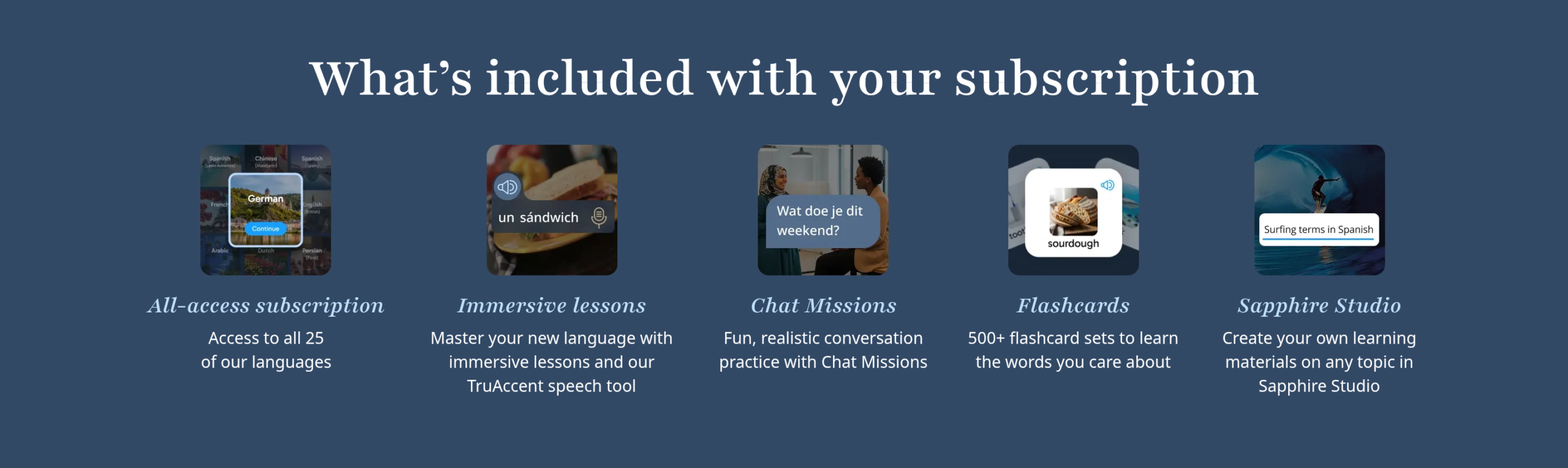
If you used Rosetta Stone years ago, the version you’ll sign up for now isn’t the same product. Rosetta Stone, which has been owned by IXL Learning since 2021, announced Rosetta Stone Sapphire on August 4, 2026. A September post on the company blog says Sapphire is available for new subscribers in the US and worldwide, and every membership covers all 25 languages.
Sapphire keeps the two things Rosetta Stone is known for, the Dynamic Immersion method and TruAccent speech recognition, and adds three new pieces:
- Chat Missions are scenario-based conversations, like ordering at a café in Paris. You work toward set goals and get guidance on grammar, spelling, vocabulary and phrasing, and the missions adjust to your level.
- Flashcards come in more than 500 topic sets per language, with images and audio.
- Sapphire Studio lets you build your own flashcards, matching games, vocabulary lists and reading activities at your level.
The press release also describes 30-minute live, one-on-one sessions with certified Rosetta Stone tutors. The checkout page doesn’t list tutoring among what a subscription includes, though, so confirm it on your plan before you count on it.
Two other changes matter for buyers. The Rosetta Stone checkout page now shows only a monthly and a yearly plan, with no lifetime option. And the old app still appears in app stores as Rosetta Stone Classic, which is a different product from Sapphire. If you see a cheap lifetime deal on a third-party site, check which app it gives you before you buy.
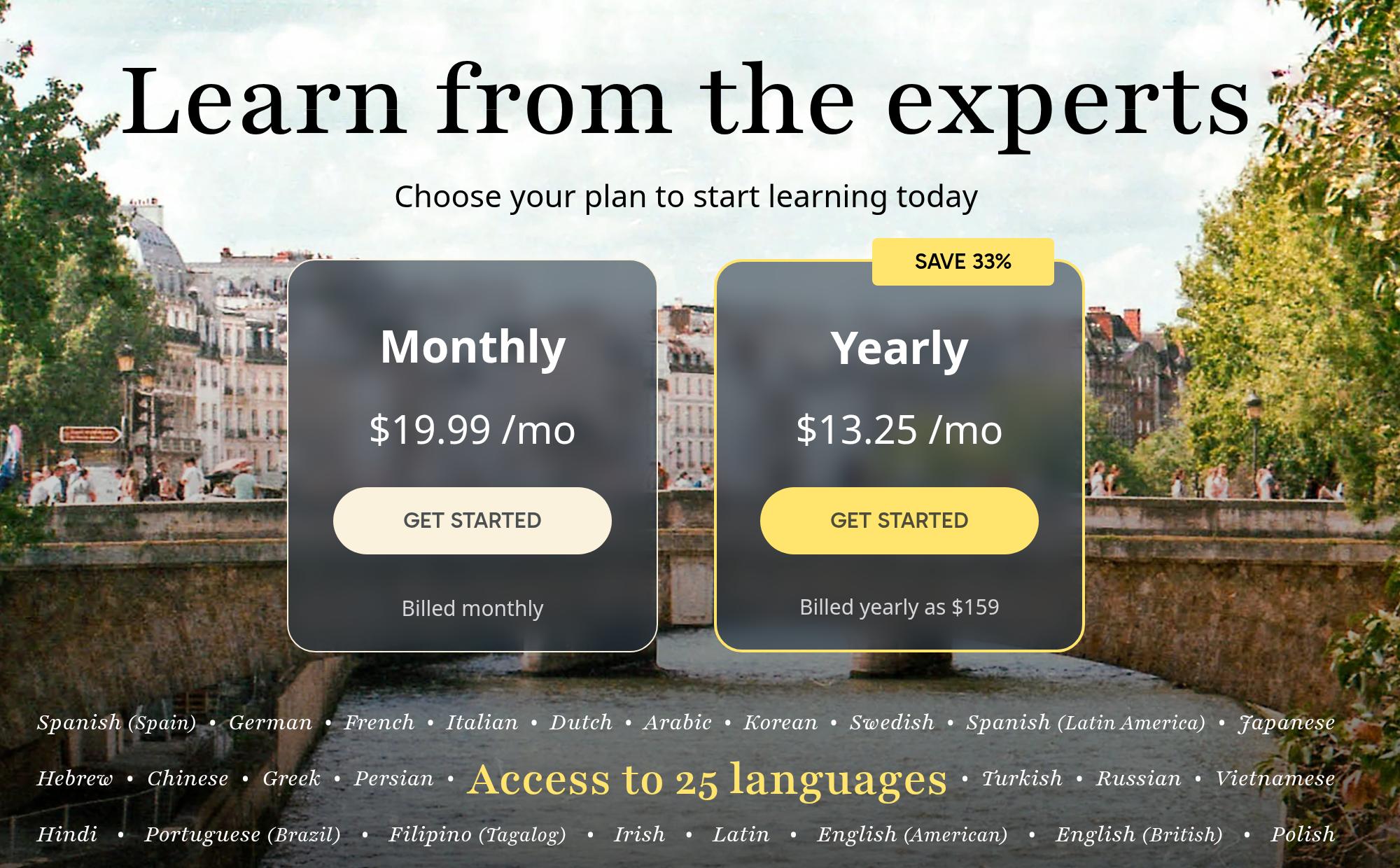
Rosetta Stone also has no free tier. When we tried to sign up, every route ended at a paid plan at checkout, so you can’t open a lesson without choosing a plan first. That’s why this comparison doesn’t include screenshots from inside a Rosetta Stone lesson.
What Each App Costs per Hour of Practice
Comparing $159 to $0 makes Rosetta Stone look expensive, and comparing $159 to $84 makes the gap look small. Neither number tells you much on its own, because you’re really paying for practice time. So I divided each plan’s yearly cost by the hours you’d get from studying 10, 20 or 30 minutes a day for a year.
| Plan (yearly cost) | 10 min a day (61 hrs) | 20 min a day (122 hrs) | 30 min a day (183 hrs) |
|---|---|---|---|
| Duolingo free ($0) | $0.00 | $0.00 | $0.00 |
| Super Duolingo, yearly ($83.99) | $1.38 | $0.69 | $0.46 |
| Super Duolingo, monthly for a year ($155.88) | $2.56 | $1.28 | $0.85 |
| Rosetta Stone, yearly ($159) | $2.61 | $1.31 | $0.87 |
| Rosetta Stone, monthly for a year ($239.88) | $3.94 | $1.97 | $1.31 |
Here’s what jumps out. Rosetta Stone on a yearly plan at 20 minutes a day costs about the same per hour ($1.31) as Super Duolingo at 10 minutes a day ($1.38). Put in the time and the premium app stops being the expensive one. Skip days and even a cheap plan turns into a poor deal.
That’s also why I wouldn’t pay Rosetta Stone monthly for long. Twelve monthly payments add up to $239.88, about $81 more than the yearly plan. Try one month, then switch to yearly if you’re sticking with it.
Duolingo prices move around more than Rosetta Stone’s. The $83.99 yearly and $12.99 monthly Super prices were reported for the US in October 2026. Duolingo’s own Super page doesn’t list prices (it leads with a one-week free trial), and it often shows different offers by device and account. Expect Super to land somewhere between $80 and $120 for a year.
Immersion vs Translation: How Each App Teaches
Rosetta Stone teaches the way you learned your first language. You see a picture, hear a native speaker and match the two, with no English on screen. Grammar isn’t explained in lists. You’re meant to work it out from patterns as the lessons build. Rosetta Stone calls this Dynamic Immersion.
Duolingo takes the opposite approach. Its lessons mix translation in both directions with tapping words into order, matching pairs, listening and short speaking prompts. Each lesson takes a few minutes, and you earn points, keep a streak and compete in weekly leagues.
Each method has a real cost. Immersion can feel slow and confusing at first, especially for grammar that doesn’t exist in English, like gendered nouns or verb cases. Without a translation, you can’t always tell why an answer was wrong. Translation-based drills feel faster, but they make it easy to keep thinking in English and converting word by word, which slows you down in a real conversation.
If you get frustrated when you don’t understand why, Duolingo will feel kinder. If you like puzzles and want to stop translating in your head, Rosetta Stone’s approach is worth the patience.
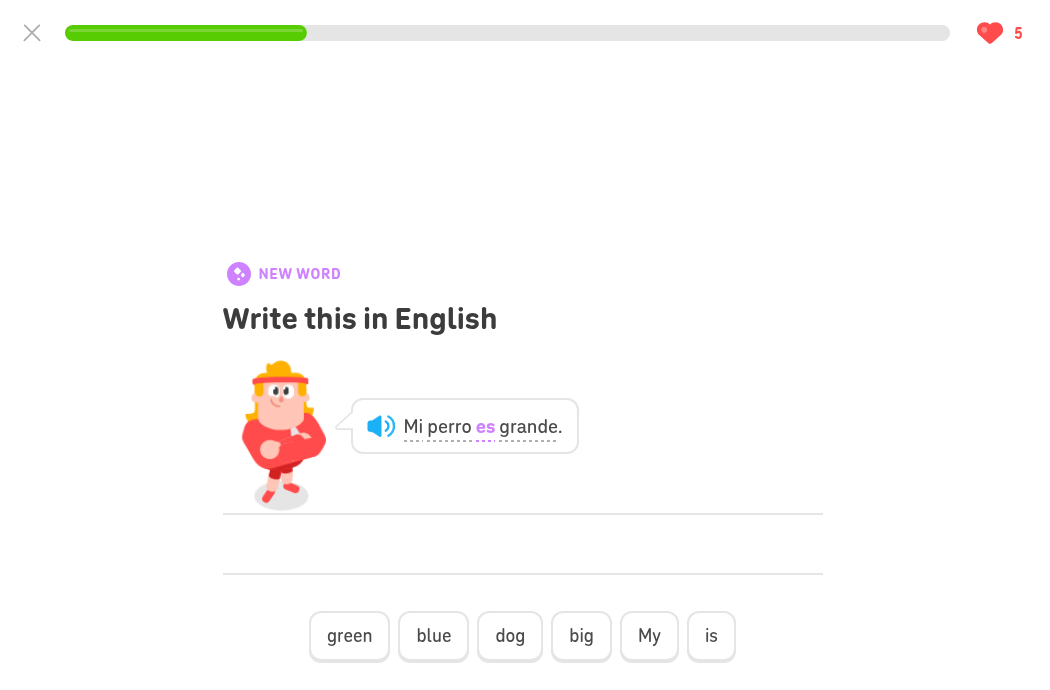
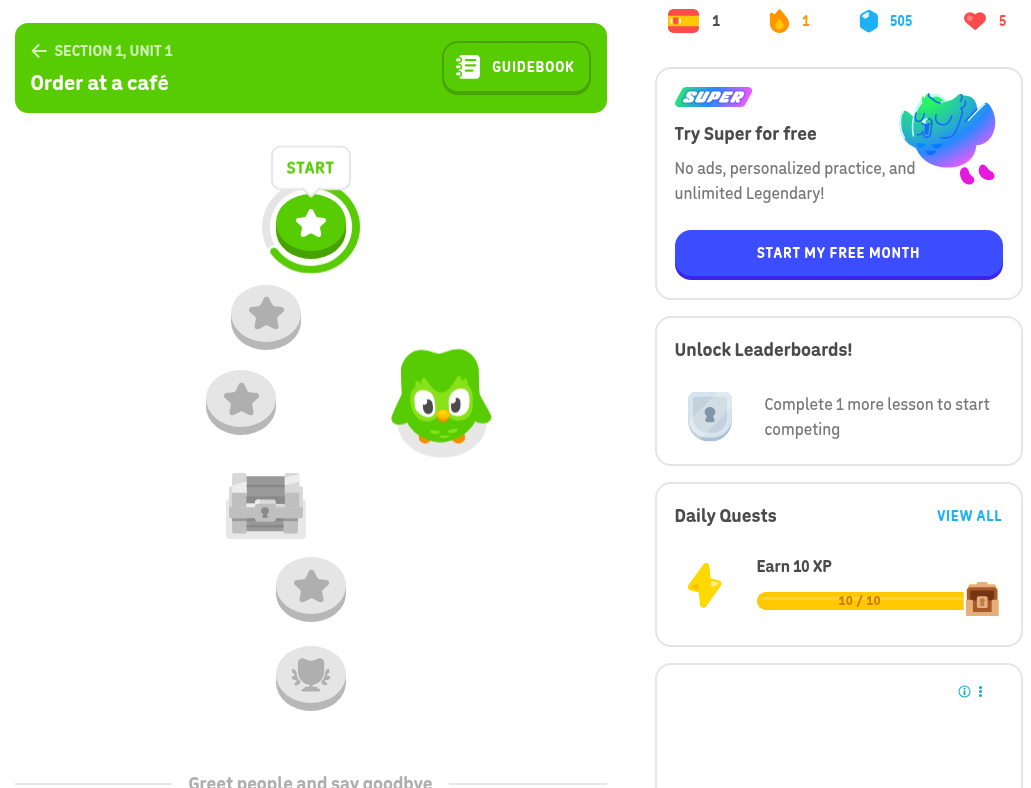
For the Duolingo side, we created a free account and completed the first lesson. Exercises like this one translate between Spanish and English, the opposite of Rosetta Stone’s no-translation method.
Speaking and Pronunciation Practice
Rosetta Stone has the stronger pronunciation tools. TruAccent, its speech recognition engine, checks how you say words and phrases throughout the lessons, and speaking is part of the core course rather than an optional exercise. For learners who care about sounding natural, it’s the main reason to pay for Rosetta Stone.
Duolingo includes speaking exercises in most courses, where you read a phrase aloud and the app accepts it or asks you to try again. They’re useful for getting comfortable speaking, but the feedback is lighter. Duolingo’s more advanced speaking feature is AI Video Call, a spoken conversation with an AI character. It started on the top Max tier, and Duolingo’s Q2 2026 shareholder letter reports that it now reaches most new Super subscribers. It isn’t offered in every language, so check yours.
Neither app replaces talking with a real person. Rosetta Stone’s Chat Missions are written, not spoken, and Duolingo’s video calls are with an AI character. If holding a conversation is your goal, plan to add a tutor or a conversation partner once you have the basics.
Languages and Dialects: Which App Teaches Yours?
Duolingo teaches more languages, and Rosetta Stone teaches more versions of the big ones. Duolingo offers about 40 courses to English speakers, including less common choices such as Norwegian, Welsh and Navajo. Rosetta Stone lists 25 courses, and all of them come with every subscription.
Where Rosetta Stone stands out is dialect choice. It runs separate courses for Spanish from Spain and Spanish from Latin America, and for American and British English. That matters more than people expect. If you’re moving to Madrid, the pronunciation and some everyday words differ from what you’d hear in Mexico City. Rosetta Stone also teaches Tagalog and Farsi, which aren’t on Duolingo’s English menu.
Before you choose, open both apps’ language lists and confirm your exact language and region. It’s the fastest way to rule one of them out.
Do Either App’s Studies Hold Up?
Both companies point to research, and most of it was funded by the companies themselves. Treat the headline numbers as marketing that happens to have data behind it.
For Rosetta Stone, the best-known independent look came from Gillian Lord, a Spanish professor at the University of Florida. Her study, published in 2015 in The Modern Language Journal, compared a regular beginning Spanish class with classes that used Rosetta Stone. The university’s summary says students who used Rosetta Stone were weaker at communicating by the end of the semester. They needed more clarification and fell back on English more often.
For Duolingo, a Duolingo-funded 2012 study by Roumen Vesselinov and John Grego estimated that 34 hours of Duolingo covered a first college semester of Spanish. The same researchers had earlier put Rosetta Stone at 55 to 60 hours for the same material, but in that study many participants dropped out early. More recent Duolingo research, published in Foreign Language Annals, measured reading and listening rather than speaking.
No study has compared the two apps head to head with the same group of learners using current versions. The fair takeaway is that both apps help beginners build vocabulary and comprehension, and neither has strong proof that it builds conversation skills on its own.
Which App Will You Actually Keep Using?
Duolingo wins on bringing you back tomorrow. Streaks, daily reminders, leagues and quick lessons are designed to fit into small gaps in your day, and for many people that habit is what makes progress happen at all.
Rosetta Stone leaves the motivation to you. Lessons are longer and more serious, and there’s no league to protect. That suits disciplined learners who block out study time. For anyone who struggles to stay consistent, it’s a real risk, because a $159 yearly plan only pays off if you use it.
The flip side is that Duolingo’s game features can reward the wrong thing. It’s easy to keep a long streak alive with the easiest possible lesson each night and stop moving forward. If you go with Duolingo, judge yourself by the units you finish, not the streak count.
Weak Spots to Know Before You Pay
Rosetta Stone
- No real free version, just a sample lesson
- Grammar is rarely explained directly, which can leave you guessing
- Few habit tools, so it’s easy to drift
- Lifetime plans are no longer sold on its own site
- Fewer languages than Duolingo
Duolingo
- The free tier has ads and limits on back-to-back lessons
- Light grammar explanations
- Translation-heavy lessons can keep you thinking in English
- Its best speaking feature, Video Call, needs a paid plan and isn’t in every language
- Prices vary by device and account
Pick the Right App for Your Situation
You have no budget, or doubt you’ll keep at it
Duolingo free. Use it for a month and see if the habit holds before paying for anything.
You care most about pronunciation and sounding natural
Rosetta Stone. TruAccent and the immersion method put speaking at the center.
You need a specific dialect, like Spain Spanish or British English
Rosetta Stone, which runs separate courses for each.
Your language is less common, like Norwegian or Welsh
Duolingo, which has the bigger language list.
You study 20 minutes or more a day and want one serious course
Rosetta Stone on the yearly plan. At that pace, it costs about $1.31 per hour of practice.
You want both
Pay for Rosetta Stone as your main course and keep free Duolingo for quick vocabulary review.
Rosetta Stone vs Duolingo FAQs
Is Rosetta Stone better than Duolingo?
Rosetta Stone is better for immersion and pronunciation, and Duolingo is better for free access, language choice and motivation. For most beginners on a budget, Duolingo is the smarter starting point.
How much does Rosetta Stone cost in 2026?
In the US, Sapphire is $159 for a year, about $13.25 a month, or $19.99 if you pay month to month. Every plan includes all 25 languages.
Can you still buy Rosetta Stone lifetime?
Not from Rosetta Stone’s own checkout page, which now lists only monthly and yearly plans. Third-party lifetime deals may cover the older Classic app rather than Sapphire, so read the fine print.
Can Duolingo or Rosetta Stone make you fluent?
Not on their own. Both can take you through beginner and early intermediate material, but fluent speaking takes regular conversation with real people, plus reading and listening outside the app.
Is Rosetta Stone good for Spanish?
Yes, especially if you need a specific variety. It offers separate courses for Spain Spanish and Latin American Spanish, which Duolingo doesn’t.
Bottom Line: Start Free, Then Decide
Start with free Duolingo. If you’re still studying after a few weeks and wish you had better pronunciation feedback or fewer translations, try one month of Rosetta Stone at $19.99, then move to the $159 yearly plan if it clicks.
If you already know you learn best by immersion, need a particular dialect or will study 20 minutes or more a day, go straight to Rosetta Stone. Either way, your daily minutes will decide your progress far more than the app you pick.
You reached the last module. 3 in 100 do.
Keep going in Languages:
TopicLanguages