
The best app for turning commutes and chores into speaking practice, with 50+ languages on All Access. Vocabulary is narrow and reading is light, so pair it with Babbel or a tutor.
- Speaking practice 25%9.0
- Teaching method 20%7.0
- Depth by level 20%5.0
- Habit and motivation 15%7.0
- Value for money 15%7.0
- App and offline 5%8.0
- You speak out loud from the first minute
- Hands-free lessons for commutes and chores
- Strong accent and listening practice
- 50+ languages on All Access
- CarPlay, Android Auto and offline downloads
- Small vocabulary for the time invested
- Little reading, writing or grammar
- Repetitive lesson format
- Subscriptions don't refund unused time
On this page
- How the Pimsleur Method Works
- What You Get Beyond the Audio
- Pimsleur Pricing in 2026
- What It Costs to Finish a Full Pimsleur Course
- What Can You Actually Do After Pimsleur?
- Which Pimsleur Level Should You Start With?
- A Weekly Routine That Gets the Most From Pimsleur
- Pimsleur Pros and Cons
- Pimsleur Compared With Other Language Apps
- Who Should Use Pimsleur?
- Pimsleur Review FAQs
- Bottom Line on Pimsleur
The short Pimsleur review: no app gets you speaking and understanding everyday phrases with less screen time. Each lesson is a 30-minute audio session that prompts you to answer out loud, so you can learn while driving, walking or cooking. In 2026, plans start at $14.95 a month for audio only, and $20.95 a month gets you more than 50 languages. The catch is a narrow vocabulary and very little reading or grammar, so Pimsleur works best as your speaking tool, not your only tool.
- Plans range from $14.95 a month (audio only) to $20.95 a month or $164.95 a year for All Access, per Pimsleur’s US course pages in November 2026.
- Lifetime purchases are available per level, per full course or for every language.
- Most major languages have five levels of 30 lessons, each about 30 minutes long.
- Premium and All Access each start with a free week and add an AI Voice Coach, flashcards and reading lessons.
- Lifetime and full-course buyers can request a refund within 30 days. Subscriptions can be canceled anytime, but unused time isn’t refunded.
How the Pimsleur Method Works
Pimsleur is based on research by Dr. Paul Pimsleur, a linguist who developed his courses in the 1960s. Every lesson follows the same pattern. A narrator plays a short conversation between native speakers, breaks it into pieces and asks you to repeat them. Then it asks you to produce phrases yourself, pausing so you can answer before you hear the correct version.
Four ideas shape the course:
- Graduated interval recall: new words come back at growing intervals, a few seconds later, then minutes, then in later lessons, so they move into long-term memory.
- Anticipation: you’re asked to say something before you hear it, which forces you to retrieve the word rather than just recognize it.
- Core vocabulary: the course teaches a limited set of very common words thoroughly instead of many words lightly.
- Organic learning: grammar and pronunciation are absorbed through speaking practice, not memorized as rules.
The result feels very different from tapping through an app. You’re talking for most of the 30 minutes. Many learners say they surprised themselves in their first real conversation because the responses came out without effort.
What You Get Beyond the Audio
The core lessons work on any plan, on the web, in the mobile app and on your car’s dashboard screen with CarPlay or Android Auto. Premium and All Access add practice tools around them, according to Pimsleur’s own course pages:
- Voice Coach: AI pronunciation feedback that compares your speech with native speakers.
- Digital flashcards and Speed Round: quick games to drill each lesson’s vocabulary.
- Reading lessons: roughly 100 short reading lessons in a full Spanish course, so you learn to recognize written words.
- Role-play transcripts and cultural notes: the written version of each dialogue plus context about where and how phrases are used.
- Quizzes and challenge mode: extra review to check what stuck.
- Offline downloads: useful for flights and areas with weak signal.
These extras fill some of the gaps in pure audio learning, but they’re still light compared with a reading-and-writing app like Babbel.
Pimsleur Pricing in 2026
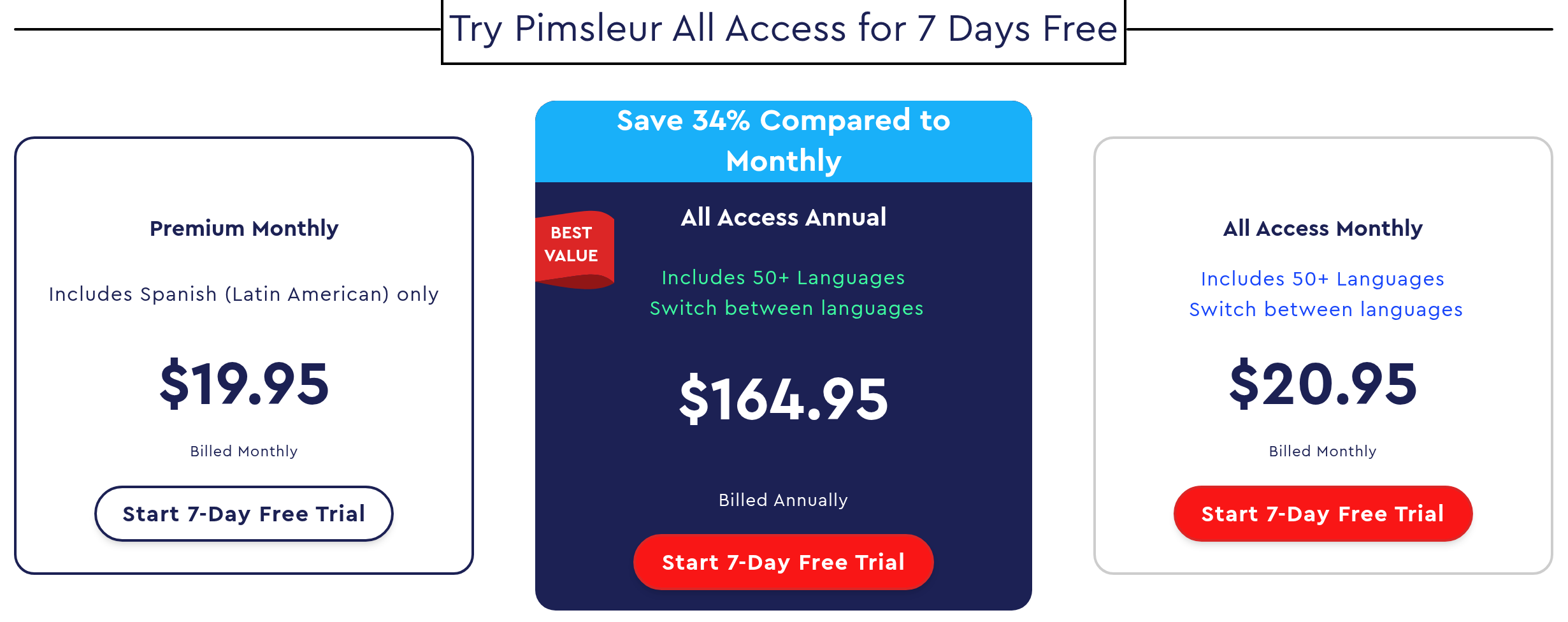
Here’s the price list on Pimsleur’s US course pages in November 2026:
| Plan | Monthly | Yearly | Languages |
|---|---|---|---|
| Audio-only | $14.95 | Not offered | One |
| Premium | $19.95 | Not listed | One |
| All Access | $20.95 | $164.95 | All 50+ |
If you’d rather pay once, Pimsleur also sells lifetime access. List prices are $150 for a single level of 30 lessons, $575 for a complete course in one language and $798 for All Access Lifetime. At the time of writing, Pimsleur’s lifetime page shows them on sale for $105, $402.50 and $478.80. If you buy lifetime access and change your mind, you can get your money back within 30 days.
Notice how small the gap is between Premium and All Access. For $1 more a month, you get every language instead of one, which makes All Access the obvious pick on monthly billing unless you’re certain you’ll only ever study one language.
What It Costs to Finish a Full Pimsleur Course
Pimsleur’s pricing makes more sense when you work out the cost of finishing a full five-level course, which is 150 lessons or about 75 hours of audio. The answer depends almost entirely on how fast you go.
| Your pace | Time to finish 150 lessons | Premium monthly | All Access yearly | Complete course lifetime |
|---|---|---|---|---|
| One lesson a day | About 5 months | About $100 | $164.95 | $402.50 to $575 |
| Five lessons a week | About 7 months | About $140 | $164.95 | $402.50 to $575 |
| Three lessons a week | About 12 months | About $240 | $164.95 | $402.50 to $575 |
| Two lessons a week | About 18 months | About $360 | About $330 | $402.50 to $575 |
A few clear lessons come out of this:
- Daily learners should pay monthly. At a lesson a day, you’ll finish a whole course for about $100 and can cancel when you’re done.
- Yearly wins if you’ll take longer than about eight months, which covers most people with busy weeks.
- Lifetime rarely pays off for one language. It only makes sense if you’ll replay the course for years, share it with family or want to own it outright. For multiple languages, All Access Lifetime at its sale price is better value.
What Can You Actually Do After Pimsleur?
This is where expectations matter. Pimsleur’s speaking practice is excellent, but its scope is narrow by design. The courses focus on a few hundred high-frequency words and the phrases built from them. Univext, a competing app, estimates learners know about 500 words after three levels.
That’s enough to handle many travel situations: greetings, directions, ordering food, shopping, talking about your family and making plans. Your accent and listening speed will likely be better than with most apps. But you won’t be able to follow a TV show, read a newspaper or discuss complex topics. The material stays at beginner and intermediate level.
The best results come from pairing Pimsleur with something that fills its gaps:
- A reading-and-grammar app such as Babbel for written skills and explanations.
- A tutor on italki or Preply once you finish two levels, to practice unscripted conversation.
- Podcasts or shows for natural listening practice beyond the course dialogues.
Which Pimsleur Level Should You Start With?
Most people should start at Level 1, even if they studied the language in school. The first lessons move slowly, but they set up the pronunciation and response habits the rest of the course depends on. If Level 1 feels too easy after a handful of lessons, skip ahead in chunks of five or ten lessons until it starts to stretch you.
Here’s a rough guide to what each stage covers in a five-level course:
| Stage | Roughly what you can handle |
|---|---|
| Level 1 | Greetings, basic questions, numbers, simple requests and directions |
| Level 2 | Ordering, shopping, talking about time and making simple plans |
| Level 3 | Describing past events, family, work and longer back-and-forth exchanges |
| Levels 4 and 5 | Everyday conversation on familiar topics with more natural speed |
Smaller languages often have fewer than five levels, so check the course page for your language before you plan a long-term subscription around it.
A Weekly Routine That Gets the Most From Pimsleur
The method rewards consistency more than long sessions. Pimsleur itself suggests one lesson a day, and the spaced review inside each lesson is built around that rhythm. A routine like this works for most busy adults:
- Monday to Friday: one new lesson on your commute or walk, answering out loud every time.
- Saturday: 10 minutes of flashcards and a reading lesson in the app.
- Sunday: replay the lesson you found hardest that week, or rest.
- Every 30 lessons: book a single tutor session to test your new phrases with a real person.
If a lesson feels shaky, repeat it the next day rather than moving on. Pimsleur’s later lessons assume you’ve mastered the earlier ones, and pushing ahead too fast is the most common reason people stall around Level 2.
Pimsleur Pros and Cons
Reasons to choose it
- You’re speaking out loud from the first minute
- Hands-free lessons fit commutes and chores
- Strong focus on accent and listening
- More than 50 languages on All Access
- CarPlay, Android Auto and offline downloads
Reasons to look elsewhere
- Small vocabulary compared with how long the course takes
- Little reading, writing or grammar explanation
- Repetitive lesson format
- Mostly beginner to intermediate material
- Subscriptions don’t refund unused time
Pimsleur Compared With Other Language Apps
| App | Main format | Better than Pimsleur for | Pimsleur wins on |
|---|---|---|---|
| Babbel | Short screen lessons with grammar notes | Reading, writing and grammar | Speaking volume and hands-free use |
| Rosetta Stone | Picture-based immersion | Visual learners and pronunciation scoring | Learning while driving or walking |
| Duolingo | Gamified drills | Free daily habit, broad vocabulary | Real spoken responses |
| italki | Live tutors | Unscripted conversation and personal correction | Price per hour and structure |
Who Should Use Pimsleur?
You have a commute or a daily walk
Pimsleur turns that time into speaking practice.
You want to talk on a trip in a few months
One or two levels will give you useful everyday phrases.
You hate staring at screens to study
The audio-only plan at $14.95 a month covers the core lessons.
You need to read and write the language
Pair it with Babbel, or choose Babbel instead.
You’re already intermediate
Skip ahead to a higher level or book a tutor instead.
Pimsleur Review FAQs
Is Pimsleur worth the money?
Yes, for speaking and listening, especially if you study daily on a monthly plan and cancel when you finish. It’s less worth it if you need reading, writing or advanced vocabulary.
How many months does a full Pimsleur course take?
A five-level course has 150 lessons of about 30 minutes. At one lesson a day, that’s about five months.
Can Pimsleur make you fluent?
No. It gives you a strong spoken foundation and good pronunciation, but fluency needs much more vocabulary and real conversation.
Does Pimsleur have a free trial?
Yes. Premium and All Access come with seven free days. Cancel before day seven to avoid the first charge.
Is Pimsleur available at libraries?
Often, yes. Many public libraries lend Pimsleur courses on CD or through digital audio services, which is a cheap way to try the method first.
Should I choose Premium or All Access?
All Access, in most cases. It costs $1 more a month than Premium on monthly billing and covers every language, so you can switch or add a second language without paying again.
Can I use Pimsleur while driving?
Yes. The core lessons need no screen, and the app connects to most car dashboards, so you can keep your eyes on the road and answer out loud.
Bottom Line on Pimsleur
No other app turns idle minutes into this much spoken practice. Study daily on the $20.95 All Access plan, finish a course in about five months, then cancel. Just plan to add reading and a live tutor as you progress, because Pimsleur alone won’t take you past everyday conversations.
You reached the last module. 3 in 100 do.
Keep going in Languages:
TopicLanguages