
Full-immersion lessons with strong pronunciation drills, and one $159 yearly plan opens all 25 languages. Grammar is only taught by example, so learners who want rules explained should look at Babbel.
- Speaking practice 25%6.5
- Teaching method 20%6.0
- Depth by level 20%7.0
- Habit and motivation 15%6.0
- Value for money 15%8.0
- App and offline 5%7.5
- All 25 languages on one plan
- TruAccent speaking practice in almost every lesson
- Chat Missions add guided conversations
- Child voice setting suits families
- Yearly plan works out to $13.25 a month
- No English explanations of grammar
- Lessons can feel repetitive
- Speech scoring can be strict
- No lifetime plan in the official store
On this page
- What Changed With Rosetta Stone Sapphire in 2026?
- How Does Rosetta Stone’s Immersion Method Work?
- Is TruAccent Speech Recognition Any Good?
- Which Languages Does Rosetta Stone Offer?
- Rosetta Stone Pricing in 2026
- Should You Pay Monthly or Yearly? Our Break-Even Math
- Does Rosetta Stone Work? What the Evidence Says
- Rosetta Stone Pros and Cons
- How to Get More From a Rosetta Stone Subscription
- Rosetta Stone vs Babbel, Pimsleur and Duolingo
- Who Should Buy Rosetta Stone?
- Rosetta Stone Review FAQs
- Bottom Line on Rosetta Stone
This Rosetta Stone review comes down to one question: can you learn without translations? Rosetta Stone teaches every lesson entirely in the language you’re learning, using pictures and context instead of English. In 2026 it also rebuilt its app as Rosetta Stone Sapphire, and one $159 yearly plan now covers all 25 of its languages. That makes it great value for patient learners and people studying more than one language. If you want grammar rules spelled out, or you get frustrated guessing, a different app will serve you better.
- The rebuilt Sapphire app arrived on August 4, 2026, bringing Chat Missions, a Studio for making your own practice, and 500+ flashcard sets per language.
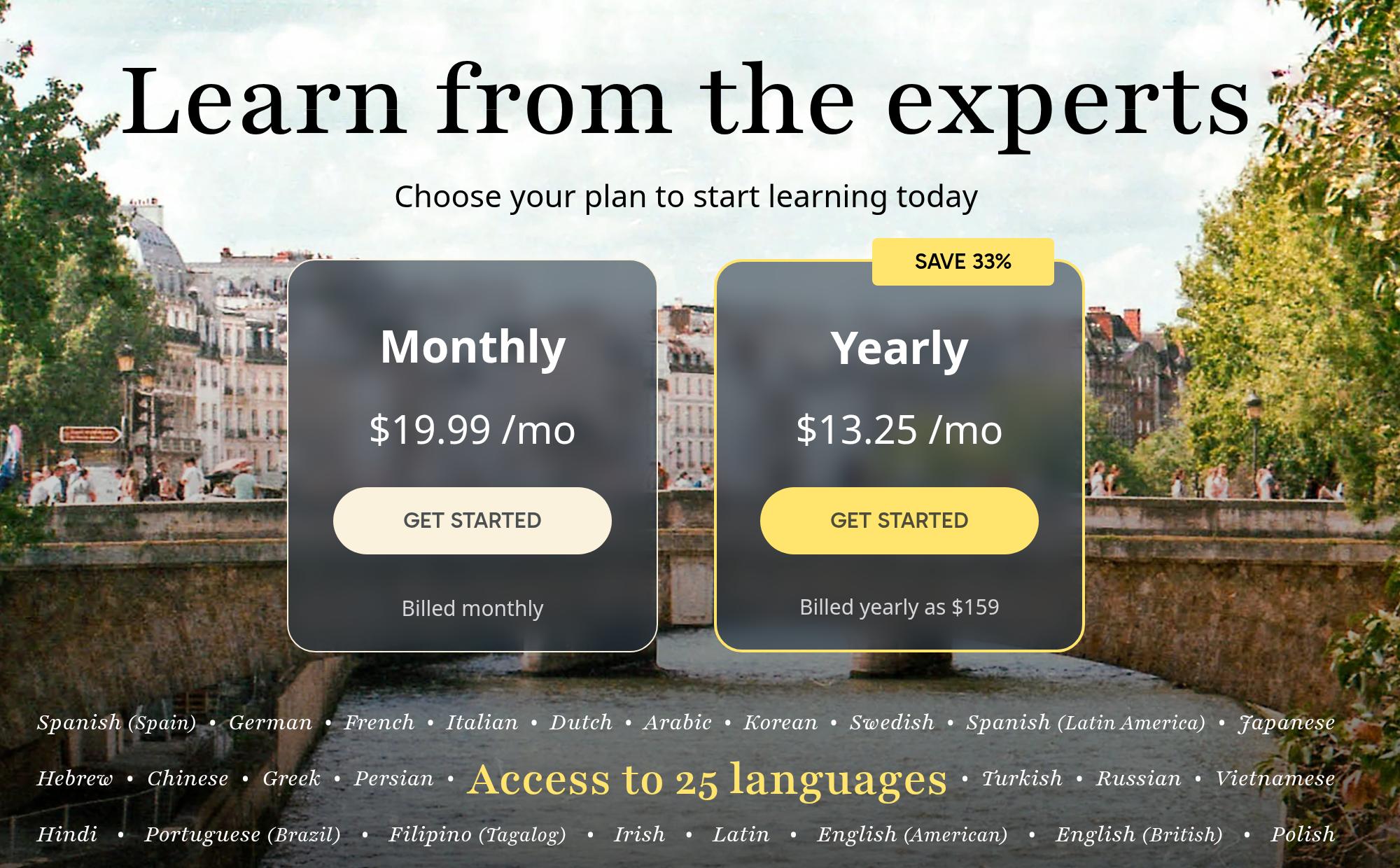
- US buyers pay $19.99 monthly or $159 for twelve months, and either plan opens all 25 languages.
- TruAccent speech recognition checks your pronunciation in almost every lesson.
- There’s a one-time 7-day free trial, and Rosetta Stone refunds orders made on its own site if you request it within 30 days.
- The official store no longer lists a lifetime plan.
What Changed With Rosetta Stone Sapphire in 2026?
Rosetta Stone dates back to 1992, and the education company IXL Learning bought it in 2021. On August 4, 2026, IXL announced Rosetta Stone Sapphire, which it calls the brand’s most ambitious product so far. The core method stayed the same, but most of the app around it is new.
The main additions are:
- Chat Missions: guided conversations for travel, social and work situations. A café mission might ask you to greet the staff, ask what’s available and place an order. Afterward it points out mistakes in your word choice, spelling, grammar and phrasing, and later missions get harder as you improve.
- Sapphire Studio: a tool for building your own flashcards, matching games, word lists and reading or writing activities.
- Flashcards: 500+ themed decks for each language, each card paired with a picture and a native recording.
- A redesigned learning path: clearer progress tracking, with units, lessons and short activities linked together.
The older app, now called Rosetta Stone Classic, still has its own section in the help center. If you see reviews describing Stories, Phrasebook or Live Lessons, they may be about Classic rather than Sapphire, so check the date before you rely on them.
How Does Rosetta Stone’s Immersion Method Work?
Rosetta Stone calls its approach Dynamic Immersion. Here’s what that means in practice. You see a picture of a boy running and hear the word for “runs.” Then you see a girl running, and then a dog. You work out the meaning from the pattern, without ever seeing the English word.
Its learning path is split into three layers:
- Units cover broad topics like work and school, or dining and vacations.
- Lessons narrow each unit down to a subtopic, such as sports and exercise.
- Activities are short drills for speaking, reading, writing and listening.
The upside is that you start thinking in the language instead of translating in your head. That habit helps a lot once you begin talking to real people. The downside is that grammar is only taught by example. You’ll pick up that adjectives change endings, for instance, but the app won’t stop to explain the rule. Many adults find that slow or confusing, especially in languages with complex grammar.
Is TruAccent Speech Recognition Any Good?
TruAccent is Rosetta Stone’s speech recognition engine, and it’s built into nearly every lesson. According to the Rosetta Stone blog, it compares what you say against millions of recordings from native speakers. It grades how well you said a word, not just whether it recognized it.
When you first open a speaking activity, you pick a voice type: adult male, adult female or child. That makes the scoring fairer, and it’s one reason homeschool families like the app. Your voice is recorded during the exercise but, Rosetta Stone says, not stored.
In reviews, people often say TruAccent can be strict. Background noise or a slightly different accent can get a correct answer marked wrong. A good headset and a quiet room help. Still, because almost every lesson includes graded speaking, you end up saying far more out loud than you would in most beginner apps.
Which Languages Does Rosetta Stone Offer?
Rosetta Stone offers 25 languages, and every plan includes all of them. That’s one of its biggest advantages. The list on its store page includes Spanish for both Spain and Latin America, Brazilian Portuguese, Japanese, Chinese, Hebrew, Greek, Persian and Hindi, plus American and British English, alongside the usual European picks like French, German and Italian.
Because the immersion method works the same way in every course, less common languages get similar structure to the popular ones. That’s not true of every app. Babbel, for example, puts most of its effort into four main languages.
Rosetta Stone Pricing in 2026
The official Rosetta Stone store lists two plans for US buyers:
| Plan | Price | What you get |
|---|---|---|
| Monthly | $19.99 a month | All 25 languages, TruAccent, Chat Missions, flashcards, Sapphire Studio |
| Yearly | $159 billed once (works out to $13.25 monthly) | Same features, about 33% cheaper than paying monthly |
A few things to know before you buy:
- Free trial: Rosetta Stone’s help center describes a one-time 7-day trial that rolls into a paid monthly plan unless you cancel.
- Free account: without paying, you can browse the curriculum, do limited daily practice and use up to 10 flashcards a day. The mobile app also unlocks the first lesson in each language.
- Refunds: the help center lists a 30-day refund promise for anything bought directly on the Rosetta Stone website. If you subscribe through the Apple App Store, refunds go through Apple instead.
- Lifetime plan: the official store no longer sells one. Lifetime keys still appear at third-party sellers, so check exactly which version of the app a key activates before you buy.
- Tutoring: IXL mentions private 30-minute lessons taught by certified Rosetta Stone instructors. Tutoring isn’t on the subscription’s feature list, so check its price before you count on it.
Should You Pay Monthly or Yearly? Our Break-Even Math
Monthly billing looks flexible, but it gets expensive quickly. Here’s what each option costs depending on how long you keep studying:
| How long you study | Monthly plan | Yearly plan | Cheaper option |
|---|---|---|---|
| 3 months | $59.97 | $159 | Monthly |
| 6 months | $119.94 | $159 | Monthly |
| 8 months | $159.92 | $159 | About even |
| 12 months | $239.88 | $159 | Yearly, saves $80.88 |
| 24 months | $479.76 | $318 | Yearly, saves $161.76 |
The break-even point is month eight. If you’re preparing for a trip a few months away, pay monthly and cancel afterward. If you’re learning a language for the long haul, or studying two at once, the yearly plan is the better deal.
The all-languages bundle also changes the math. At $159 a year, someone studying Spanish and Italian pays about $79.50 per language. A one-language app charging $100 or more a year can’t match that.
Does Rosetta Stone Work? What the Evidence Says
Rosetta Stone says more than 50 million people have learned with its method. The best-known efficacy figure comes from a 2009 study the company published itself. It found that about 55 hours of Rosetta Stone Spanish roughly matched one semester of college Spanish.
Read that result carefully. The study covered only Spanish, mostly looked at beginners, who tend to progress fastest, and was released by the company it evaluated. We haven’t found recent independent research on the new Sapphire app. That doesn’t mean it doesn’t work. It just means the evidence is thinner than the marketing suggests.
What most reviewers agree on is narrower. Rosetta Stone is good at building vocabulary, listening comprehension and pronunciation at the beginner and lower intermediate levels. It’s weaker at explaining grammar and at preparing you for fast, unscripted conversation.
Rosetta Stone Pros and Cons
Strengths
- All 25 languages included in one subscription
- Speaking practice in almost every lesson through TruAccent
- Full immersion builds listening and thinking in the language
- Chat Missions add guided conversation practice
- Child voice setting suits families and homeschoolers
Weaknesses
- No English explanations, so grammar can stay fuzzy
- Lessons can feel repetitive over long stretches
- Speech scoring can be overly strict
- No lifetime plan in the official store anymore
- Tutoring isn’t part of the listed subscription features
How to Get More From a Rosetta Stone Subscription
Immersion works best when you lean into it rather than fight it. These habits help most learners stick with the method past the first few weeks.
- Keep a short grammar reference nearby. When a pattern confuses you, look it up in a free grammar site or a pocket guide, then go back to the lesson. Five minutes of explanation can save an hour of guessing.
- Use a headset with a microphone. TruAccent scores more fairly when it hears you clearly, and you’ll spend less time repeating correct answers.
- Do a Chat Mission after each unit. Using new words in a conversation, even a guided one, makes them stick far better than flashcards alone.
- Build your own sets in Sapphire Studio. Add words from your job, hobbies or an upcoming trip so the vocabulary matches your real life.
- Set a fixed daily slot. Fifteen minutes at the same time every day beats an hour once a week.
Rosetta Stone vs Babbel, Pimsleur and Duolingo
| If you want | Better pick | Why |
|---|---|---|
| Grammar explained in English | Babbel | Every lesson includes short grammar notes |
| Hands-free practice in the car | Pimsleur | Its lessons are built around audio |
| A free daily habit | Duolingo | Free tier with streaks and game features |
| Several languages on one plan | Rosetta Stone | All 25 languages for $159 a year |
| Strong pronunciation drills | Rosetta Stone | TruAccent scores almost every spoken answer |
Who Should Buy Rosetta Stone?
You learn best by seeing and hearing, not by reading rules
Rosetta Stone’s picture-based immersion fits you well.
You want to study two or more languages
The all-languages yearly plan is hard to beat on price.
You’re teaching kids or homeschooling
The child voice setting and no-reading-needed approach work well for young learners.
You need grammar for exams or classes
Pick Babbel, or pair Rosetta Stone with a grammar book.
You’re already intermediate
Spend your money on a tutor through italki or Preply instead.
Rosetta Stone Review FAQs
Is Rosetta Stone worth it in 2026?
For visual learners and anyone studying more than one language, yes. The $159 yearly plan covers all 25 languages with strong speaking practice. If you need grammar explained in English, Babbel is a better fit.
Does Rosetta Stone still sell a lifetime subscription?
Not through its official store. Its 2026 checkout shows just two options, monthly and annual. Lifetime keys still appear at some third-party retailers.
Can you use Rosetta Stone for free?
There’s a limited free account with curriculum browsing, some daily practice and 10 flashcards a day. A full 7-day free trial is also available once per account.
Can Rosetta Stone make you fluent?
On its own, no app will. Rosetta Stone can give you a solid base in vocabulary, listening and pronunciation. Fluency comes from hundreds of hours of real listening and talking with other people.
What is the difference between Rosetta Stone Sapphire and Classic?
Sapphire is the 2026 redesign with Chat Missions, Sapphire Studio and a new learning path. Classic is the earlier app, which still has its own help section for existing users.
Bottom Line on Rosetta Stone
Rosetta Stone suits you if you’re patient, learn by example and want speaking practice from day one. The 2026 Sapphire update made it more conversational, and including all 25 languages for $159 a year makes it one of the better values in language learning. Learners who want clear grammar rules should start with Babbel instead. Either way, use the 7-day trial to check whether the no-translation style works for you.
You reached the last module. 3 in 100 do.
Up next for Rosetta Stone:
ComparisonRosetta Stone vs Duolingo