
The cheapest way to learn almost any practical skill, with 220,000+ courses and frequent sales near $13. Quality varies by instructor, so vet each course before you buy.
- Catalog quality 25%7.0
- Learning experience 20%6.5
- Value for money 20%8.5
- Certificates and outcomes 15%4.0
- Apps and usability 10%8.5
- Support and refunds 10%8.0
- Huge catalog, strongest in tech, data and certification prep
- Sale prices usually around $10 to $20 per course
- Lifetime access to courses you buy
- 30-day refund window on most single courses
- Course quality varies widely between instructors
- Completion certificates carry little weight with employers
- No deadlines or graded work in most courses
- Personal Plan has no 30-day refund guarantee
On this page
- How Udemy Works
- What’s Changed at Udemy in 2026
- Udemy Pricing in 2026
- What a Udemy Course Costs per Hour of Learning
- Why Udemy Course Quality Varies So Much
- Where Udemy Is Strongest
- What Udemy Does Well
- Where Udemy Falls Short
- Refunds, Access and the Personal Plan Catch
- Udemy vs Coursera vs Skillshare
- Who Should Use Udemy?
- Udemy Review FAQs
- Bottom Line on Udemy
Here’s our Udemy review in one line: Udemy is the cheapest way to learn almost any practical skill online, as long as you’re willing to spend ten minutes picking the right course. With more than 220,000 courses, prices that regularly drop to around $13 and lifetime access to what you buy, the value is hard to beat. The catch is that anyone can publish a course, so quality ranges from outstanding to barely usable.
This review covers how Udemy works in 2026, what it really costs, what’s changed since Coursera bought the company, what you get with a course and the problems learners report most. It’s based on Udemy’s own help center and pricing pages, independent reviews and learner feedback, checked in November 2026. Udemy earns 7.0 out of 10 from us, and the score panel above this article shows how each category contributed.
- Catalog: more than 220,000 courses for 70 million-plus learners (reported figures). Udemy’s own course pages say the Personal Plan covers 28,000+ top-rated courses.
- Price: list prices often run $20 to $200, but frequent sales bring most courses down to roughly $10 to $20.
- Subscription: the Personal Plan covers a curated set of 26,000-plus courses from about $13 a month.
- Refunds: a 30-day window on most individual courses, but not on subscriptions.
- Certificates: completion certificates are included, but they aren’t accredited.
How Udemy Works
Udemy is an open marketplace. Independent instructors create video courses, set a list price and publish them, and Udemy handles hosting, payments, promotion and frequent sitewide discounts. That’s different from Coursera, where universities and companies build the courses, or MasterClass, where the company produces every class.
When you buy a course, it’s yours for as long as Udemy offers it, including any updates the instructor adds later. Most courses combine video lectures with downloadable resources and a Q&A section where you can ask the instructor questions. Many add quizzes, coding exercises or practice tests, especially in tech and certification-prep courses.
Every course page lets you watch a few preview lectures for free, which is enough to tell whether the instructor’s style suits you. Udemy also offers free courses, which are shorter and include the videos but not extras such as a certificate.
What’s Changed at Udemy in 2026
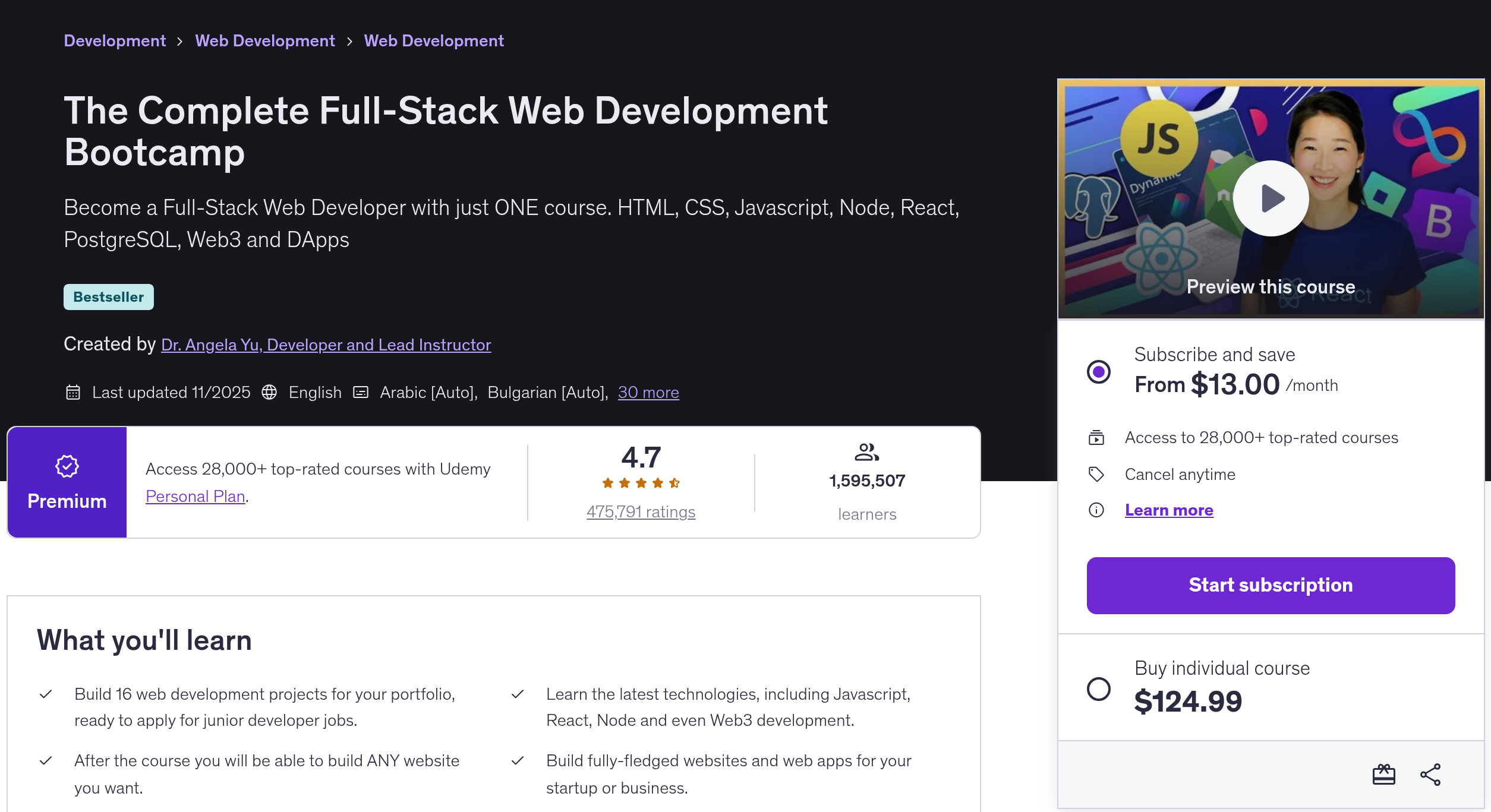
The biggest news is ownership. Udemy now belongs to Coursera, after a stock-for-stock deal that closed in May 2026. So far the change is invisible to shoppers: Udemy keeps its own website, logins, catalog, pricing and refund rules. Nothing has changed yet for someone buying a course on udemy.com.
Udemy has also changed how instructor coupons work. Instructors’ open giveaway coupons now stop working after just ten people use them, a small fraction of the old limit, which is why free codes posted online are usually dead on arrival. Discounted coupons still exist, and sitewide sales remain the main way prices drop.
Udemy Pricing in 2026
| Option | Price | What you get |
|---|---|---|
| Single course at list price | Roughly $20 to $200 | Lifetime access to one course |
| Single course on sale | Usually about $10 to $20 | Lifetime access to one course |
| Personal Plan | From about $13 a month | 26,000-plus selected courses while subscribed |
| Team Plan | About $360 per person a year | Business library for 2 to 50 people |
| Free courses | $0 | Video lessons only, no certificate |
When we checked Udemy through a US connection on November 1, 2026, new learners were offered courses from $14.99, and the Personal Plan was listed from $13.00 a month. Prices vary by country and change often, so treat any list price as a starting point. If a course isn’t on sale today, it probably will be soon.
What a Udemy Course Costs per Hour of Learning
Udemy’s sale prices barely change with course length, which makes long, well-made courses unusually cheap. Here’s what you pay per hour of video at the $12.99 sale price reported in late October 2026 (new learners saw $14.99 on November 1) compared with a $84.99 list price:
| Course length | At $84.99 list | At $12.99 on sale |
|---|---|---|
| 5 hours | $17.00 per hour | $2.60 per hour |
| 20 hours | $4.25 per hour | $0.65 per hour |
| 60 hours | $1.42 per hour | $0.22 per hour |
Two lessons come out of this. First, never pay list price. The difference is too large and sales are too frequent. Second, length isn’t quality, but a long, highly rated bootcamp-style course on sale is one of the best deals in online learning. A 60-hour coding course for the price of a sandwich is common on Udemy.
If you’ll take more than about one course a month, compare the Personal Plan. If you’ll take a few a year, buying on sale is cheaper and you keep the courses after you stop paying.
Why Udemy Course Quality Varies So Much
Udemy’s open model is its biggest strength and its biggest weakness. Anyone who meets Udemy’s basic standards can publish, so the catalog includes courses from industry professionals with hundreds of thousands of students and courses thrown together in a weekend. Ratings help, but they aren’t perfect, and learners regularly point out that a “Last updated” date can change after small edits while most of the content stays old.
A quick way to separate good courses from weak ones:
- Look for volume and rating together. A 4.6 rating from 50,000 reviews says much more than a 4.9 from 40.
- Read the newest reviews first. They show whether the course still works with current tools and software versions.
- Check the Q&A tab. Recent instructor replies mean someone still maintains the course.
- Watch two preview lectures. Audio quality and pacing tell you a lot in five minutes.
- Use the refund window. If a course disappoints in the first week, request a refund rather than pushing through.
Where Udemy Is Strongest
Udemy’s quality isn’t spread evenly. Some categories consistently have deep, well-maintained courses, often from instructors who’ve built a business around teaching on the platform:
| Category | Why it works well on Udemy |
|---|---|
| Programming and web development | Long, project-based courses that instructors update for new versions |
| IT and cloud certifications | Exam-focused courses and full-length practice tests at low prices |
| Data and analytics | SQL, Excel, Power BI and Python courses with exercises |
| Office and productivity software | Practical, step-by-step lessons you can apply at work the same day |
| Design software | Tool-specific courses for Photoshop, Figma and similar apps |
Softer categories, such as personal development and business strategy, have more variation. They’re worth a look, but read reviews even more carefully there.
What Udemy Does Well
- Price. Sale prices make even long, in-depth courses cost less than a lunch out.
- Breadth. If a practical skill exists, someone probably teaches it on Udemy, from Excel and Python to guitar and watercolor.
- Tech and certification prep. Programming, cloud certifications, data and IT courses are among the strongest on the platform, often with practice tests.
- Lifetime access. Buy once and come back years later, with updates included.
- Offline learning. The iOS and Android apps let you download lectures.
- A real refund policy. You have about a month to return most single courses.
Where Udemy Falls Short
- Uneven quality. The open marketplace means you have to vet every course yourself.
- Certificates carry little weight. A Udemy completion certificate shows effort, but employers don’t treat it like a university or industry credential.
- Little structure or accountability. There are no deadlines, cohorts or graded assignments in most courses, so many people never finish.
- Limited interaction. Q&A support depends entirely on the instructor, and some stop responding.
- Confusing pricing. Constant sales and countdown timers make list prices feel meaningless, and prices differ between the website and the app.
Refunds, Access and the Personal Plan Catch
Bought a single course you regret? Udemy’s refund rules give you a month to ask for your money back in most cases, though people who request refunds again and again can lose that option. Purchases made through Apple or Google go through those stores instead.
The Personal Plan works differently. According to Udemy’s help center, subscriptions fall outside the 30-day guarantee, so you generally can’t get money back once a billing period starts. You also lose access to subscription courses when you cancel, unlike courses you buy outright. If you’re unsure, buy single courses until you know you’ll use the platform heavily.
Udemy vs Coursera vs Skillshare
| Platform | How you pay | Who teaches | Certificate value | Best for |
|---|---|---|---|---|
| Udemy | Per course, or a subscription | Independent instructors | Low | Learning a specific skill cheaply |
| Coursera | Plus subscription, $399 for a year | Universities and companies | Higher | Career certificates and degrees |
| Skillshare | $167.88 a year | Working creatives | Low | Short creative classes with projects |
Choose Udemy when you know exactly what you want to learn and want the cheapest, deepest course on it. Choose Coursera when the name on the certificate matters to an employer. Choose Skillshare for short creative projects across many topics.
Who Should Use Udemy?
You need a specific skill for work, like Excel, SQL or a new framework
Udemy is ideal. Pick a well-reviewed course that its instructor still maintains, and wait for a sale.
You’re preparing for an IT or cloud certification exam
Udemy’s practice-test courses are popular and cheap. Check reviews from recent test takers.
You want a credential employers recognize
Look at Coursera’s Professional Certificates instead.
You struggle to finish self-paced courses
Consider a structured program with deadlines, or pair a Udemy course with a study partner.
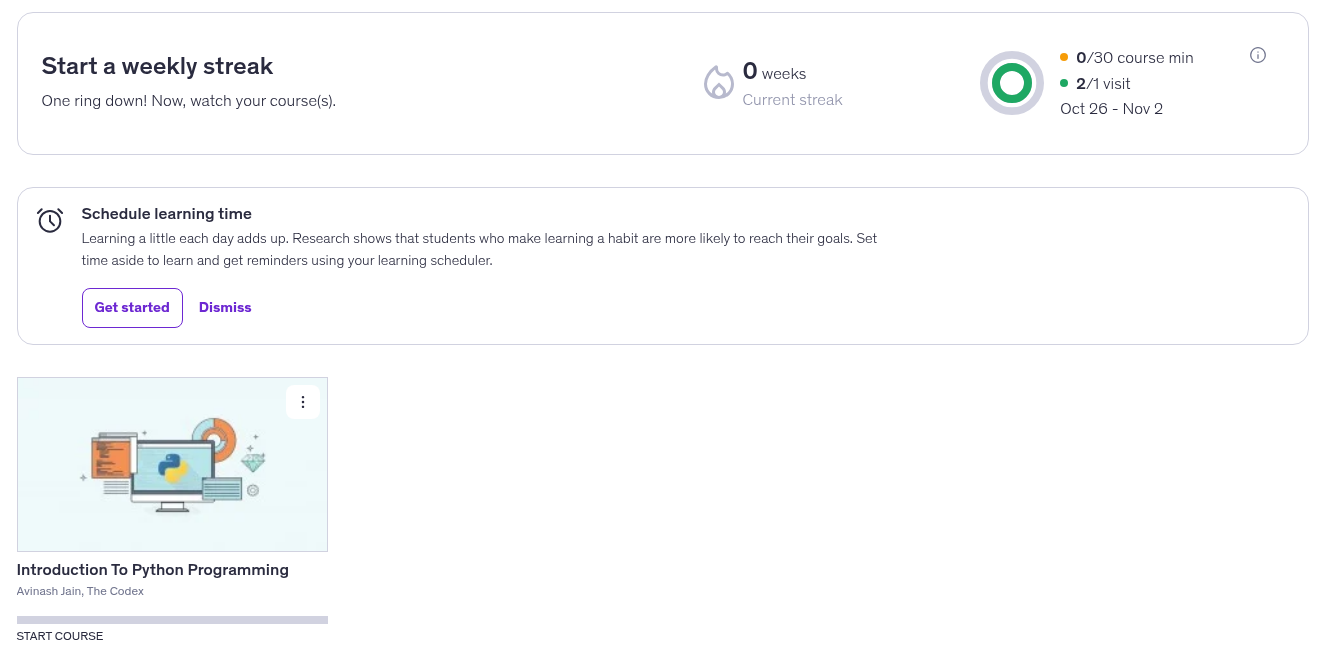
We created a free Udemy account and enrolled in a free course, Introduction To Python Programming, to see how progress tracking works. Enrolled courses sit on the My learning page with a progress bar, alongside a weekly streak goal.
Udemy Review FAQs
Is Udemy legit?
Yes. Udemy has operated since 2010, serves tens of millions of learners and is now owned by Coursera. The real question is course quality, which varies by instructor.
Are Udemy certificates worth anything?
They show you completed a course, which can support a resume or LinkedIn profile, but they aren’t accredited. What you can show you’re able to do will always count for more.
Why are Udemy courses always on sale?
Udemy runs frequent sitewide promotions, and the list price acts as a reference point. Most buyers pay a sale price, usually around $10 to $20.
Do you keep Udemy courses forever?
Purchased courses stay in your library indefinitely, unless Udemy itself removes them. Courses you access through the Personal Plan are available only while you’re subscribed.
Is the Udemy Personal Plan worth it?
It’s worth it if you’ll take more than about one course a month and the courses you want are in the subscription library. Otherwise, buying single courses on sale is cheaper.
Bottom Line on Udemy
Udemy is the best value in online learning for practical, job-ready skills, especially in tech. Buy on sale, choose courses with many recent positive reviews and use the 30-day refund window if a course doesn’t deliver.
Look elsewhere if you need a recognized credential or the accountability of deadlines and graded work. For those, a structured platform will serve you better.
You reached the last module. 3 in 100 do.
Up next for Udemy:
ComparisonCoursera vs Udemy